
Start here
Start with the exact mattress and its published weight guidance. Then check the foundation, frame or adjustable base separately. A firmer feel, taller profile or higher price does not establish the capacity of the complete bed.
Build your shortlist in three steps
First, check the mattress and base requirements. Next, compare the three models below. Finally, use the before-you-order checklist to confirm size, comfort and delivery.
These are candidates to investigate, selected from our catalog using manufacturer guidance and their different constructions. They are not the result of an independent durability test or a universal ranking. For help deciding how a mattress should feel, use our companion heavy-sleeper comfort and showroom guide.
Check the mattress and the complete bed
Write down the weight of each sleeper and the combined weight. Some manufacturers publish both an individual-sleeper recommendation and a combined recommendation. Both matter: a combined figure alone may not describe your situation.
Helix lists the Plus, Plus Luxe and Plus Elite for up to 500 pounds per sleeper and 1,000 pounds combined. Its standard Core, Luxe and Elite ranges have different recommendations: up to 300 pounds per sleeper and 600 combined. Read the Helix weight guidance for the exact range you are considering.
Tempur-Pedic states that its mattresses have no weight limit, while its foundations and adjustable bases do. This is a mattress policy, not an unlimited rating for a complete bed. See Tempur-Pedic’s explanation and check your support system separately.
| Part of the bed | What to ask |
|---|---|
| Mattress | Does the manufacturer’s guidance cover each sleeper and the combined weight for this exact model? |
| Foundation or platform | What support surface, slat spacing and center support does this mattress require? |
| Frame or adjustable base | What is its rated load? Does that figure include the mattress and other components? Which size and configuration does it cover? |
| Split setup | What are the requirements for each individual half? Do not assume one side can carry the combined rating of both. |
If the published information does not answer those questions, ask the manufacturer or our team for confirmation before ordering. Do not estimate a missing capacity from mattress thickness or the word “heavy-duty.”
Choose firmness after checking suitability
A mattress can meet a manufacturer’s weight guidance and still feel uncomfortable. Start with a feel you already like, then compare one neighboring firmness in your normal sleep position. Pay attention to pressure at the shoulder or hip, how far your middle settles, and how easily you turn.
Avoid choosing extra firm solely because of body weight. Side sleepers may want more surface cushioning, while someone who dislikes sinking may prefer a more resistant feel. Our sleep-position comparison gives you specific things to notice without treating a firmness number as a capacity rating.
Look past height, coil counts and marketing labels
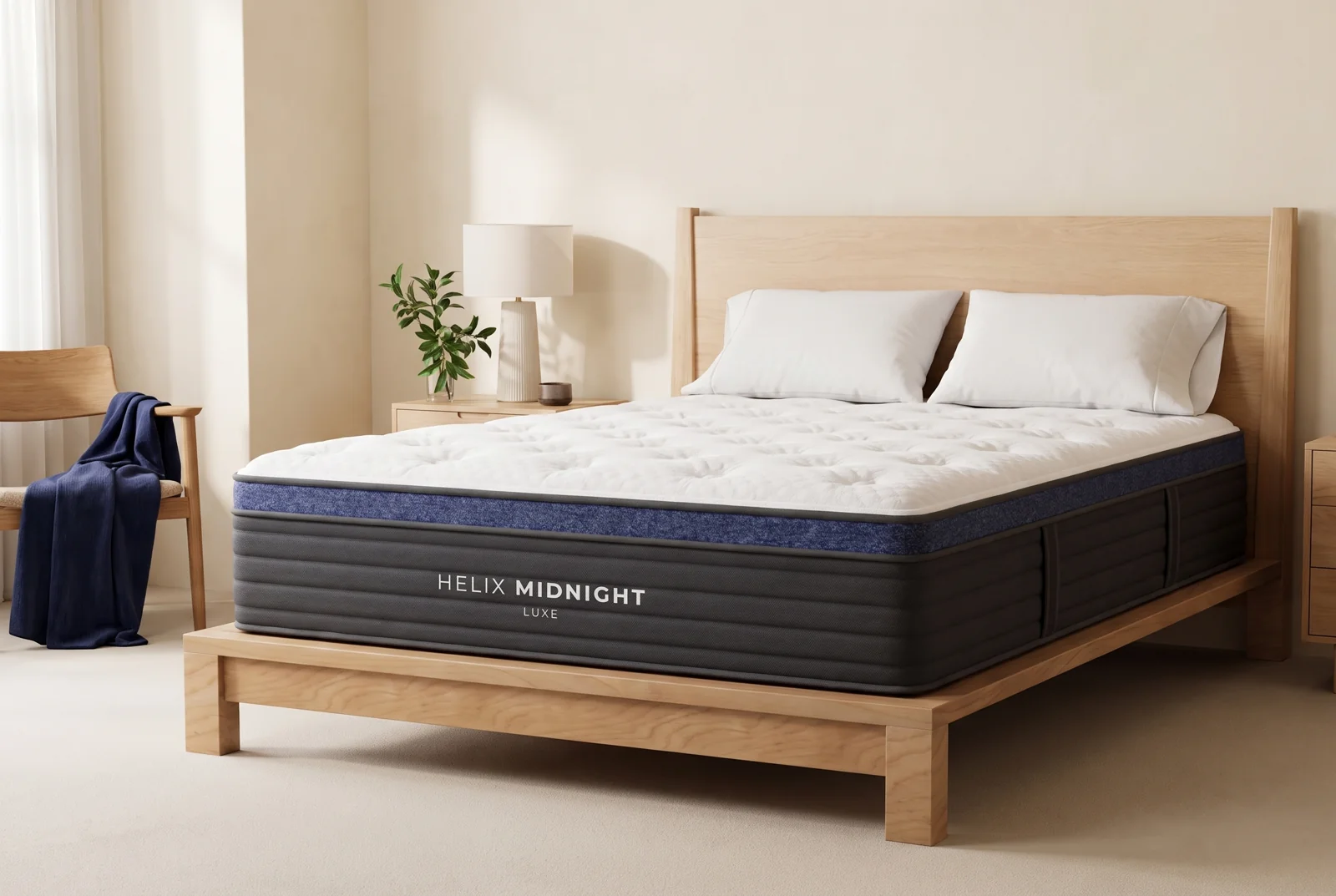
A hybrid combines comfort layers with a coil support system; an all-foam mattress uses foam for support. Compare the finished model, because the category alone does not tell you its weight guidance, comfort or service life. Ask for the construction of the version you are buying, including any changes between model years.
There is no useful universal shortcut such as “at least 12 inches” or a single minimum coil count. The Helix Plus listing below has an 11.5-inch profile; its published manufacturer guidance is more relevant than an arbitrary height cutoff. A taller mattress also changes how high you sit above the floor and which sheets and protector fit.
Use our mattress types guide to compare constructions, and measure the combined frame, foundation and mattress height before deciding.
Three mattresses to put on your shortlist
Open each product page to choose your size and see current Shopify pricing, options and availability. Prices and showroom displays can change; confirm the exact model and firmness with your chosen store before travelling.
Helix Plus 11.5-inch Firm Hybrid
A starting point if you want a hybrid from a range with explicit guidance for larger sleepers. Compare how the surface cushions you and how it feels when you change position. Its lower profile relative to the Plus Elite is worth considering if you already have a tall frame. Explore the Helix Plus.
Helix Plus Elite 15-inch Firm Hybrid
A second candidate if you want to compare a taller model within the Plus family. Try it beside the Plus rather than assuming the additional height will suit you better. Check getting in and out, fitted-sheet depth and the complete price difference. The Plus-family weight guidance cited above covers both; a higher price does not mean a higher published limit. Explore the Helix Plus Elite.
Tempur-Pedic TEMPUR-ProAdapt Firm 12-inch
An all-foam option to compare with the two hybrids if you prefer a firm, conforming feel. Spend time turning and sitting at the edge as well as lying still. Use Tempur-Pedic’s mattress policy and confirm the approved support surface and the base’s capacity; firmness alone is not the suitability check. Explore the TEMPUR-ProAdapt Firm.
Match the shortlist to your priorities
| Your priority | Useful next step |
|---|---|
| Explicit individual and combined guidance | Start with the Helix Plus family, then verify the rest of the bed. |
| Comparing foam with a hybrid | Try the ProAdapt Firm beside a Plus model and record turning effort and pressure. |
| Keeping the bed easy to enter | Measure your existing setup and test the finished sitting height. |
| Different preferences between partners | Test together; compare movement and usable space before exploring separate firmnesses. |
These candidates are less useful if you have not yet checked a worn foundation, if the complete setup exceeds a component’s rating, or if the mattress causes discomfort during testing. Choose a different setup rather than assuming the mattress will compensate for an unsuitable frame.
Bring this checklist to your LA showroom
- Your preferred mattress size and the full model names you want to compare.
- Each sleeper’s needs and the combined weight, shared privately with the team if you prefer.
- A photo, model number and measurements of your existing frame or base.
- Your usual sleep position, pillow preference and what bothers you about your current bed.
- Your budget for the mattress, suitable support, bedding and delivery together.
Choose an LA showroom and confirm display availability. Ask the team to check the manufacturer’s support instructions: Helix base requirements and Tempur-Pedic support requirements are different, so do not transfer one brand’s rules to another.
Before payment, review the comfort-exchange terms, warranty process and delivery arrangements. Use the total-cost planner to compare complete setups in the same size.

Questions about mattresses for larger sleepers
What should I look for if I weigh more than 300 pounds?
Start with model-specific individual and combined weight guidance, then check the foundation and frame. Our support checklist explains the separate questions to ask.
Is an extra-firm mattress automatically better?
No. Firmness describes feel, not the capacity of the mattress or base. Compare comfort using the showroom testing guide after confirming the model’s suitability.
Will a mattress topper fix a sagging bed?
A topper does not repair a failed support component or establish a higher weight capacity. Identify whether the issue is the mattress, foundation or frame; our warranty guide explains how to document a possible defect.
Can I use an adjustable base?
Confirm both the mattress’s compatibility and the exact base’s rated load and configuration. Start with adjustable bases and ask our team to check the complete pairing.
Leave with a confirmed setup, not just a model name
Keep a record of the mattress model, size, selected feel, approved support system, complete price and written terms. A useful shortlist becomes a good purchase when the whole setup fits your needs.
Ready to compare comfort? Continue with the showroom comparison checklist, or contact our team with the models you are considering.


