
Guide to mattress types
Memory foam, hybrid, innerspring, or latex, how the four mattress types actually feel, who each one fits, and what to watch out for.

Feel all four types in-store
Foam, hybrid, innerspring & latex, side-by-side
Free next-day delivery
On LA orders over $499 · same-day $100 by 4 PM
120-night comfort exchange
Picked the wrong feel? Swap it.
The four mattress types at a glance
Start with the construction and feel you prefer. Explore each profile, then compare the qualities that matter to you.
Memory foam
$$Body-hugging contour and the best motion isolation we sell.
Often chosen by
Trade-off: Sleeps warmer and feels less bouncy than coils or latex.
Construction & feel of Memory foam
Layers, top to bottom
- Knit cover
- Memory foam comfort layer
- Transition foam
- High-density base foam
Illustrative construction and relative ratings; individual models vary.
Hybrid
$$$Pocketed coils for support and airflow, foam on top for contour.
Often chosen by
Trade-off: Heavier to move and usually costs more than all-foam.
Construction & feel of Hybrid
Layers, top to bottom
- Quilted cover
- Foam / latex comfort layer
- Pocketed coil support unit
- High-density base foam
Illustrative construction and relative ratings; individual models vary.
Innerspring
$A traditional coil core, bouncy, breathable, supportive.
Often chosen by
Trade-off: Less motion isolation and a thinner comfort layer than foam.
Construction & feel of Innerspring
Layers, top to bottom
- Pillow-top / comfort layer
- Steel coil core
- Support base
Illustrative construction and relative ratings; individual models vary.
Latex
$$$Buoyant, breathable, and the longest-lasting material we carry.
Often chosen by
Trade-off: Higher upfront cost and a springy feel some foam fans dislike.
Construction & feel of Latex
Layers, top to bottom
- Talalay latex comfort layer
- Dunlop latex transition
- High-density support base
Illustrative construction and relative ratings; individual models vary.
$–$$$ indicates relative price. Construction diagrams are illustrative; layers vary by model.
Feel comparison at a glance
More filled dots means more of that quality, on a relative scale of 1–5. Use these profiles as a starting point; individual models vary.
Swipe or scroll across to compare all four types.
| Feel | Memory foam | Hybrid | Innerspring | Latex |
|---|---|---|---|---|
| Pressure relief | ||||
| Support | ||||
| Cooling | ||||
| Motion isolation | ||||
| Responsiveness | ||||
| Durability |
Find your starting point
A closer look at your options
Four mattress types account for almost every bed we sell: memory foam, hybrid, innerspring, and latex. Each one has a different feel, a different price range, and a different best-fit sleeper. Here's the honest comparison.
Memory foam
The feel: contour. Memory foam responds to body heat and pressure, so it slowly molds around your shoulders and hips and holds you in place. The first few seconds feel firm; after a minute it's a hug.
Best for: side sleepers who want pressure relief; couples where one partner is a restless sleeper (foam absorbs motion better than any other material); anyone with joint pain or arthritis; cold sleepers.
Watch out for: heat retention. Standard memory foam runs hot, not great for LA summers in older homes without AC. Look for gel-infused or open-cell foams (most modern foams now have cooling tech).
Price range: from value memory-foam options up to Tempur-Pedic at the premium end. Browse all memory foam mattresses →
Hybrid
The feel: contour plus bounce. A hybrid is a pocketed-coil base topped with foam, latex, or both. The coils give you support and breathability; the comfort layer gives you the cushion. Most modern mattresses sold today are hybrids. They're the safest pick if you're not sure what you want.
Best for: combo sleepers who change position throughout the night; heavier sleepers who need extra support; hot sleepers (coils breathe far better than solid foam); couples with mismatched comfort preferences.
Watch out for: nothing major, hybrids are the most forgiving category. The variation is in the comfort layer: a foam-topped hybrid feels more like foam, a latex-topped hybrid feels more like latex.
Price range: from Helix in the mid range up to Stearns & Foster at the top. Browse all hybrid mattresses →
Innerspring
The feel: firm and supportive. Traditional coil mattress, usually with a thin pillow-top or quilted cover. Bouncy, breathable, predictable.
Best for: stomach sleepers (firm support keeps the spine straight); back sleepers who want a firmer feel; sleepers who run hot or sweat at night; budget-conscious buyers (innerspring is generally the most affordable category).
Watch out for: motion transfer (you'll feel your partner move) and a shorter useful lifespan than foam or hybrid (coils sag faster than dense foam).
Price range: mostly value tier. Browse all innerspring mattresses →
Latex
The feel: responsive without the slow-sink. Latex contours like foam but bounces back faster, so you don't feel “stuck.” Natural latex breathes well and lasts longer than any other material we sell.
Best for: hot sleepers (latex sleeps cooler than memory foam); sleepers with joint pain who want contour without heat retention; eco-conscious buyers (natural latex is GOLS-certified, biodegradable); allergy sufferers (latex resists dust mites and mold).
Watch out for: price (latex is the most expensive category, ounce-for-ounce); weight (a latex mattress is heavy, which matters if you flip it or move often).
Price range: mid to premium. Browse all latex mattresses →
How to pick
Two questions narrow it fast:
- How do you sleep? Side → foam or foam-topped hybrid. Back → hybrid or innerspring. Stomach → firmer hybrid or innerspring. Combo → hybrid.
- Do you run hot at night? Yes → hybrid, latex, or innerspring. No → any category.
For a more tailored fit, take our 8-question sleep quiz and we'll recommend a category and a starting collection.
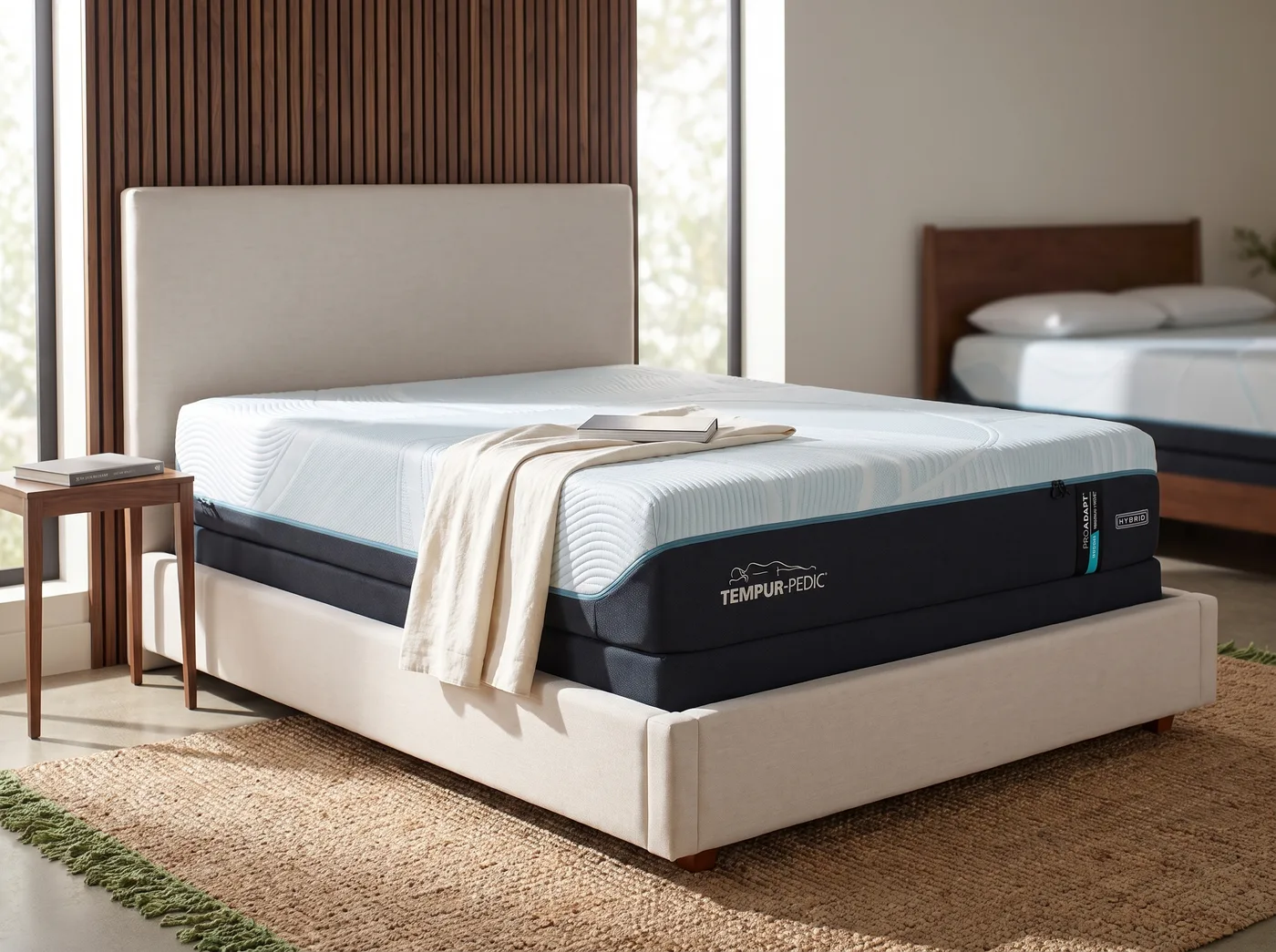
The fastest way to decide: lie on them
Mattress feel is hard to describe in words. You really need 5 minutes on each type to know what works for you. Stop by any of our five LA showrooms and try all four types side-by-side. Free white-glove delivery on orders over $499, 120-night comfort exchange, no commission-only sales.
Tools to narrow down your mattress choice
Still deciding which type is right?