
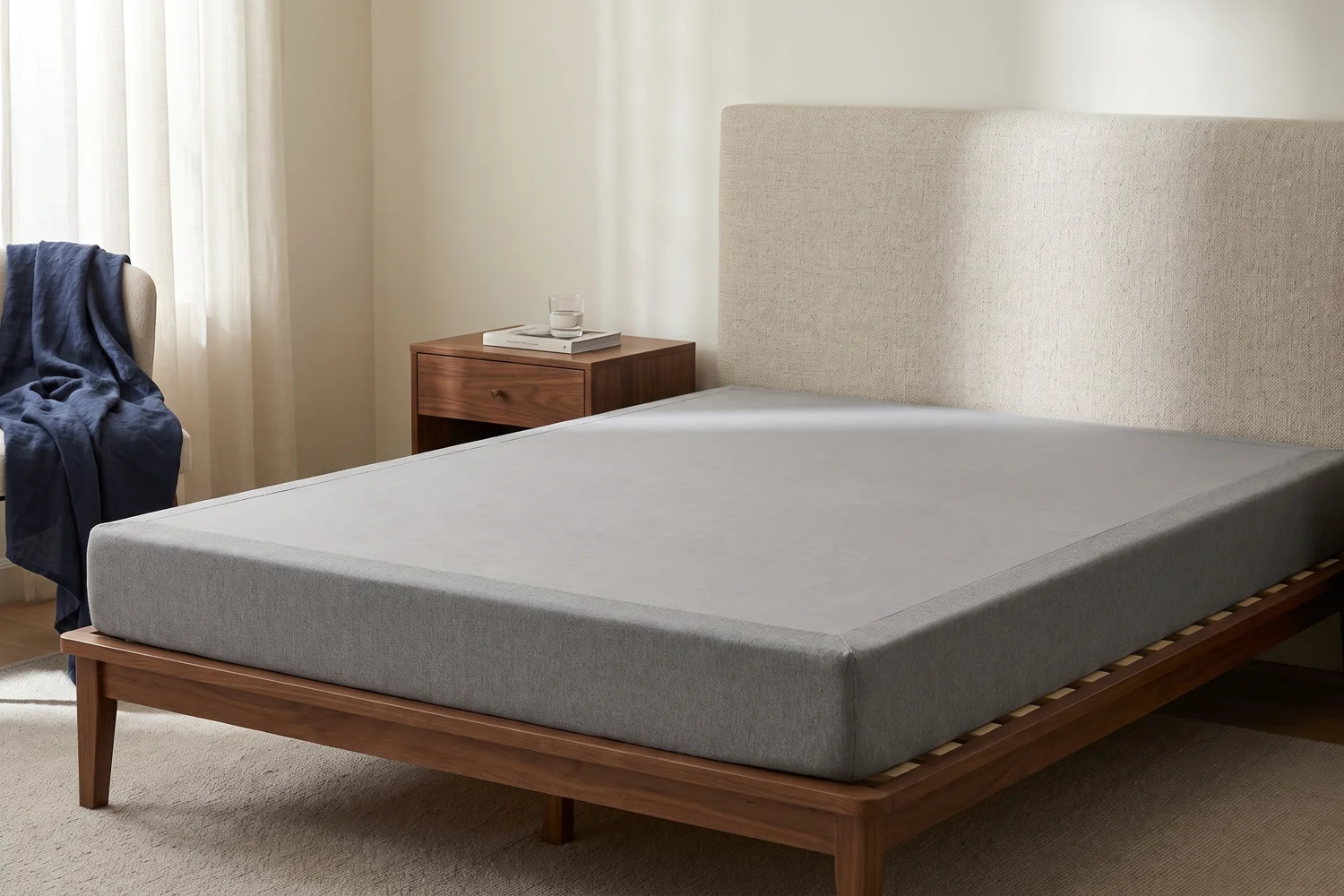
Choose the required support first, then its height. “Low profile” describes a shorter support; it does not establish construction or compatibility. Add the frame’s support height, foundation thickness and mattress height to compare finished setups.
- Choose the support
Start with the mattress manufacturer’s requirements.
- Compare the height
Add the frame, foundation and mattress together.
- Confirm the whole setup
Check size, access and what the purchase includes.
Four options, four different jobs
- Spring-containing
Box spring
A support with springs that can flex. Use it only when your mattress is designed for that type of support.
- A rigid layer
Foundation
A nonflexing support held by an appropriate frame. Verify its surface and the mattress’s requirements.
- Built into the bed
Platform bed
Its own support may replace a separate foundation when the complete surface is approved for your mattress.
- A thinner surface
Bunkie board
A low-height support surface within a suitable frame. Check the board and the structure beneath it.
Retail names can overlap. A product called a “box spring” may actually be a rigid foundation. Check the construction before choosing.
You may not need another layer
Inspect the platform’s support surface and compare it with your mattress requirements before adding anything. An extra foundation changes finished height and may leave less headboard visible. It does not make an unsuitable platform automatically compatible.
Use the step-by-step guide to check your existing mattress support.
Know what a bunkie board can do
A bunkie board may add an approved surface while keeping the mattress lower. Confirm the board’s dimensions, material and required support beneath it. It must not bridge a damaged frame or replace structural parts that the bed manufacturer requires.
Do not substitute a random sheet of plywood for a specified support product without checking the mattress and frame instructions.
Compatibility before profile
Memory foam and hybrid describe broad mattress constructions, not a universal support rule. Check the exact model’s requirements for surface, slats, center support and size. If you want the bed to move, use the separate mattress compatibility checklist.
Low profile changes the whole bed
Measure from the floor to the ledge that will carry the foundation. Add the foundation and mattress heights. Use the support ledge—not the frame’s full outside height.
One example · 7-inch frame support + 12-inch mattress
Navy: mattress · Sand: foundation · Outline: frame support
These are example measurements, not a universal recommended bed height. Sit on the actual mattress, check getting in and out, and compare your nightstand and headboard. The mattress compresses under you.
TEMPUR-Flat foundations offer 9-, 5- and 2-inch profiles. Check your selected size and the frame’s requirements.
Two ways to keep the profile lower
These are foundation-only products. Check the exact size, pieces included and support requirements on the product page. A photo showing a mattress or bed frame does not make those items part of the foundation purchase.

Compare the 5-inch profile when you want to add less height than a 9-inch foundation. Confirm the selected size and support requirements.
See options & current price
The 2-inch profile adds three inches less height than the 5-inch option. Check the frame, required support and pieces included in your size.
See options & current priceCheck the selected size and what is included. Room furnishings and other bed components shown may be sold separately.
Foundation and height questions
Clarify the details before choosing. Ask our team about your particular setup.
Is a low-profile foundation less supportive?
Height alone does not tell you whether the construction is suitable. Compare the exact product and mattress requirements in the foundation collection.
Do I need two pieces for a King or California King?
Many larger foundations come as two pieces. Confirm the complete set and correct length; King and California King are different sizes. See the size comparison.
Can I reuse a foundation from another brand?
Only after checking the new mattress’s requirements and the support’s condition. Start with our guide to check your existing mattress support.
Does the mattress trial cover the foundation?
Do not assume it does. Read the product’s return terms and the mattress comfort-exchange policy before purchase.
Bring the pieces together
List the mattress, support, frame and services in the total-cost planner. Bring your measurements and model names to a showroom to compare the finished setup before ordering.