Free Local White-Glove Setup & Haul-Away on Orders Over $499Announcement 1 of 2
Explore Payment Options — View Financing DetailsAnnouncement 2 of 2
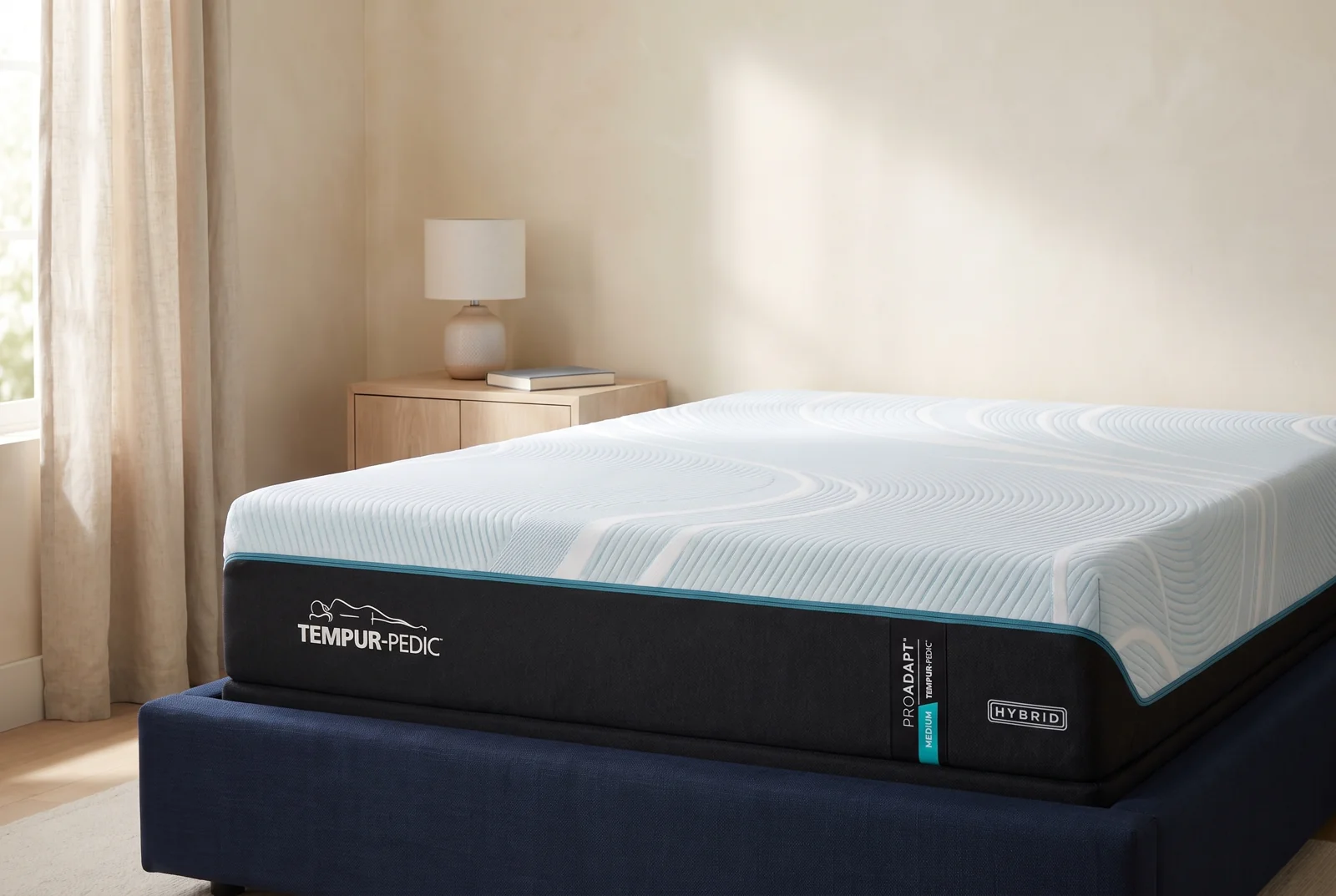
Tempur-Pedic TEMPUR-ProAdapt Medium HybridStyled product scene
Back pain and poor sleep feed each other. A mattress that sags, sits too firm, or doesn't support your spine properly can make both worse, and keep you stuck in that cycle night after night.
This guide breaks down the best queen-size mattresses for back pain relief: what features actually matter, which mattress types work best for different sleep positions, and specific picks available at LA Mattress Store.
Not all "back pain mattresses" are created equal. These are the features that genuinely make a difference:
Your spine has a natural S-curve. A good mattress keeps that curve supported in any position, not flattening it (too firm) or letting it sag (too soft). This is the most important factor, full stop.
For side sleepers especially, pressure buildup at the hips and shoulders causes pain that radiates into the lower back. A mattress needs enough give in those areas to cushion without collapsing.
Zoned support systems, where coils or foam are differentiated by body zone, give extra firmness under the lower back while staying softer at the shoulders. This is worth paying for if you have chronic lower back issues.
A mattress that starts supportive but sags within two years is worse than useless. Look for high-density base foams, reinforced coil systems, and brands with solid warranties.
If you share the bed, motion transfer can interrupt sleep and make pain worse. Pocketed coils and foam layers both help here.
Pain disrupts sleep, and overheating disrupts sleep. Gel-infused foam, breathable covers, and coil-based airflow help keep you comfortable through the night.
Expert tip: "Medium-firm" is the most commonly recommended feel for back pain, but it's a starting point, not a rule. Your weight, sleep position, and the cause of your pain all affect what actually works for your body.
| Sleep Position | Ideal Firmness | Why |
|---|---|---|
| Back sleeper | Medium to medium-firm | Supports lumbar without flattening natural curve |
| Side sleeper | Medium to medium-soft | Cushions hips and shoulders, keeps spine level |
| Stomach sleeper | Firm | Prevents hips from sinking, avoids lower back arch |
| Combination sleeper | Medium | Adaptable feel across positions |
This is the pick for people who want premium support without sacrificing comfort. It combines a dual-stage IntelliCoil® HD coil system, built to respond to body weight zone by zone, with TEMPUR-Indulge™ memory foam on top for pressure relief without the sinky feeling of all-foam beds.
The PrecisionEdge™ perimeter keeps the sleeping surface stable edge-to-edge, which matters if you share the bed or tend to sleep near the side. A moisture-wicking stretch-knit cover keeps things cooler than typical pillow-top covers.
| Pros | Cons |
|---|---|
| Zoned coils provide targeted lumbar support | Premium price point (~$2,899 Queen) |
| Pillow top comfort without alignment compromise | Heavy, white glove delivery recommended |
| Cooling moisture-wicking cover | Needs periodic rotation for even wear |
| Strong edge support across full surface | May feel too firm for petite side sleepers |
View the Stearns & Foster Luxe Estate →
If you're a back or stomach sleeper and your budget is under $600, this delivers genuine support without bells and whistles. Pocketed coils paired with dense foam layers give you solid spinal alignment. It's lightweight, easy to work with, and straightforward, no gel swirls or phase-change fabrics, just support that holds up.
| Pros | Cons |
|---|---|
| Strong spinal support at an accessible price (~$499) | No cooling technology |
| Lightweight, easy to rotate | Too firm for side sleepers or lighter builds |
| Clean, durable construction | Minimal comfort layers |
View the Spring Air Hughes Firm →
The standout feature here is the responsive gel grid layer. It moves with you as you shift positions rather than creating resistance or leaving you stuck. Zoned coils underneath provide targeted lumbar support while the CoolTouch cover manages temperature. If you or your partner changes positions regularly through the night, this is the pick.
| Pros | Cons |
|---|---|
| Gel grid layer adapts across all sleep positions | Mid-range price (~$1,699) |
| Excellent active cooling | Less bouncy than pure latex |
| Zoned coils for lumbar support | May feel too soft for firm-preference sleepers |
| Good motion isolation for couples |
View the Diamond Gravity Hybrid →
TEMPUR-APR® foam is uniquely dense and adaptive. It cradles pressure zones in a way standard memory foam doesn't. Paired with reinforced pocketed coils for structure and bounce, this hybrid gives you the deep contouring that people with pressure-related back pain need, without the "stuck" feeling of all-foam beds. The SmartClimate® cooling cover addresses memory foam's biggest downside.
| Pros | Cons |
|---|---|
| Exceptional pressure relief at hips and shoulders | Premium price (~$2,499) |
| SmartClimate® cover reduces heat retention | Very heavy |
| Excellent motion absorption for partners | Can feel too dense for lighter sleepers |
| Adapts to unique body shape |
View Tempur-Pedic mattresses at LA Mattress →
Natural latex is the most underrated material for back pain support. It's responsive (not sinky like memory foam), breathes well, and holds its shape for years longer than most foams. The Lucille combines an organic cotton cover with a natural latex support core, no off-gassing, no synthetic chemicals, and a medium-firm to firm feel that keeps the spine supported without excess pressure on joints.
| Pros | Cons |
|---|---|
| Excellent natural breathability and temperature control | Initial latex scent that dissipates within days |
| Long lifespan, latex typically outlasts foam | Less body-contouring than memory foam |
| Hypoallergenic, dust mite resistant | May feel too firm for side sleepers |
| No synthetic materials or off-gassing |
| Mattress | Type | Firmness | Best For | Cooling | Price (Queen) |
|---|---|---|---|---|---|
| Stearns & Foster Luxe Estate | Hybrid | Firm Pillow Top | Back pain, couples | Yes | ~$2,899 |
| Spring Air Hughes Firm | Innerspring | Firm | Back/stomach sleepers | No | ~$499 |
| Diamond Gravity Cool Gel Grid | Hybrid | Medium | Combo sleepers, hot sleepers | Yes | ~$1,699 |
| TEMPUR-ProAdapt Medium Hybrid | Hybrid | Medium | Side sleepers, pressure relief | Yes | ~$2,499 |
| Diamond Lucille Natural Latex | Latex | Medium-Firm to Firm | Back sleepers, eco-conscious | Natural | ~$1,899 |
This guide is not a substitute for medical advice. If you have chronic or severe back pain, consult a physician or physical therapist alongside your mattress search.
Every spine is different. The single best thing you can do is test mattresses in person, lie in your actual sleep position for at least 10 minutes per bed. LA Mattress Store has five showrooms across Los Angeles where you can do exactly that, with staff who can help narrow down options based on your sleep position, body type, and pain pattern.
All mattresses come with our 120-Night Comfort Guarantee, if it's not working for your back after a few months, we'll help you find a better fit.
If your back pain is worse when you wake up and improves after you've been moving for 20–30 minutes, the mattress is likely contributing. Pain that stays the same or gets better when you sleep elsewhere is another sign.
No. Very firm mattresses can create pressure points at the hips and shoulders that throw the spine out of alignment, especially for side sleepers. Medium-firm is the sweet spot for most people, but your weight and sleep position matter too.
Medium-firm hybrids and supportive memory foam models perform best across the widest range of back pain situations. Latex is excellent for people who want support without the sinky feel. The "best" type depends on your sleep position.
Yes, when it's paired with a supportive base. Memory foam alone (without a firm enough base or coil support) can let your hips sink too deep and misalign the spine. Hybrids that combine memory foam with coils tend to work better for back pain than all-foam beds.
Most people need 2–4 weeks to fully adjust. Some people feel better immediately; others notice temporary increased soreness for the first week as their body adapts. If you're still in pain after 30 days, it may not be the right match.
Not necessarily. Platform beds and adjustable bases both provide proper support. What matters is that the base is stable, flat (or appropriately articulating), and doesn't sag.
Look for mattresses with strong motion isolation and a medium feel that works for both positions. Split king setups (two twin XL mattresses) are another option that lets each person customize their side completely.
Every 3–6 months for most mattresses. Rotating (head-to-foot) promotes even wear. Unless the manufacturer specifies otherwise, don't flip. Most modern mattresses are one-sided.
Yes. Latex is responsive and supportive without the deep sink of memory foam. It's particularly good for back sleepers and combination sleepers who need their spine supported across positions. It also sleeps cooler than memory foam.
All mattresses featured here are available to test in person at LA Mattress Store's five LA showrooms. Our sleep specialists can help you find the right fit based on your sleep style and back pain situation.
Start with a mattress type that suits how you sleep, then compare the feel in person.
Prices for Queen · Choose options for other sizes


Est. $124.84/month for 6 months
Item-price payoff target · excludes taxes and fees.
Synchrony · No interest if paid in full within 6 months. Subject to credit approval.
Interest is charged from the purchase date if not paid in full in time. Minimum monthly payments are required and may not repay the balance in time.
This item price meets the 6-month deferred-interest threshold. We use the longest confirmed period available at this price. Avoiding interest requires paying the promotional balance in full before the deadline. Lender fees can affect total cost; this selection does not establish the lowest total borrowing cost.
This illustration divides the displayed price of $749.00 for one selected item by 6 months, rounding up to the next cent. It is not the lender’s required payment or billing schedule. Check the promotional deadline on your statement and pay the full promotional balance before it ends.
Taxes, delivery, recycling charges and any lender promotional fees are excluded. Fees may add to the total borrowing cost. Additional discounts can change plan eligibility and the amount financed. Confirm the final purchase amount and applicable terms with the store before arranging financing.
Credit approval, applicable account terms and purchase eligibility apply.
How Synchrony deferred interest works
Est. $158.17/month for 6 months
Item-price payoff target · excludes taxes and fees.
Synchrony · No interest if paid in full within 6 months. Subject to credit approval.
Interest is charged from the purchase date if not paid in full in time. Minimum monthly payments are required and may not repay the balance in time.
This item price meets the 6-month deferred-interest threshold. We use the longest confirmed period available at this price. Avoiding interest requires paying the promotional balance in full before the deadline. Lender fees can affect total cost; this selection does not establish the lowest total borrowing cost.
This illustration divides the displayed price of $949.00 for one selected item by 6 months, rounding up to the next cent. It is not the lender’s required payment or billing schedule. Check the promotional deadline on your statement and pay the full promotional balance before it ends.
Taxes, delivery, recycling charges and any lender promotional fees are excluded. Fees may add to the total borrowing cost. Additional discounts can change plan eligibility and the amount financed. Confirm the final purchase amount and applicable terms with the store before arranging financing.
Credit approval, applicable account terms and purchase eligibility apply.
How Synchrony deferred interest works
Est. $146.50/month for 6 months
Item-price payoff target · excludes taxes and fees.
Synchrony · No interest if paid in full within 6 months. Subject to credit approval.
Interest is charged from the purchase date if not paid in full in time. Minimum monthly payments are required and may not repay the balance in time.
This item price meets the 6-month deferred-interest threshold. We use the longest confirmed period available at this price. Avoiding interest requires paying the promotional balance in full before the deadline. Lender fees can affect total cost; this selection does not establish the lowest total borrowing cost.
This illustration divides the displayed price of $879.00 for one selected item by 6 months, rounding up to the next cent. It is not the lender’s required payment or billing schedule. Check the promotional deadline on your statement and pay the full promotional balance before it ends.
Taxes, delivery, recycling charges and any lender promotional fees are excluded. Fees may add to the total borrowing cost. Additional discounts can change plan eligibility and the amount financed. Confirm the final purchase amount and applicable terms with the store before arranging financing.
Credit approval, applicable account terms and purchase eligibility apply.
How Synchrony deferred interest works
Est. $91.63/month for 24 months
Item-price payoff target · excludes taxes and fees.
Synchrony · No interest if paid in full within 24 months. Subject to credit approval.
Interest is charged from the purchase date if not paid in full in time. Minimum monthly payments are required and may not repay the balance in time.
This item price meets the 24-month deferred-interest threshold. We use the longest confirmed period available at this price. Avoiding interest requires paying the promotional balance in full before the deadline. Lender fees can affect total cost; this selection does not establish the lowest total borrowing cost.
This illustration divides the displayed price of $2,199.00 for one selected item by 24 months, rounding up to the next cent. It is not the lender’s required payment or billing schedule. Check the promotional deadline on your statement and pay the full promotional balance before it ends.
Taxes, delivery, recycling charges and any lender promotional fees are excluded. Fees may add to the total borrowing cost. Additional discounts can change plan eligibility and the amount financed. Confirm the final purchase amount and applicable terms with the store before arranging financing.
Credit approval, applicable account terms and purchase eligibility apply.
How Synchrony deferred interest works
Est. $92.42/month for 12 months
Item-price payoff target · excludes taxes and fees.
Synchrony · No interest if paid in full within 12 months. Subject to credit approval.
Interest is charged from the purchase date if not paid in full in time. Minimum monthly payments are required and may not repay the balance in time.
This item price meets the 12-month deferred-interest threshold. We use the longest confirmed period available at this price. Avoiding interest requires paying the promotional balance in full before the deadline. Lender fees can affect total cost; this selection does not establish the lowest total borrowing cost.
This illustration divides the displayed price of $1,109.00 for one selected item by 12 months, rounding up to the next cent. It is not the lender’s required payment or billing schedule. Check the promotional deadline on your statement and pay the full promotional balance before it ends.
Taxes, delivery, recycling charges and any lender promotional fees are excluded. Fees may add to the total borrowing cost. Additional discounts can change plan eligibility and the amount financed. Confirm the final purchase amount and applicable terms with the store before arranging financing.
Credit approval, applicable account terms and purchase eligibility apply.
How Synchrony deferred interest worksBuying guides and sleep advice, no email signup required.