
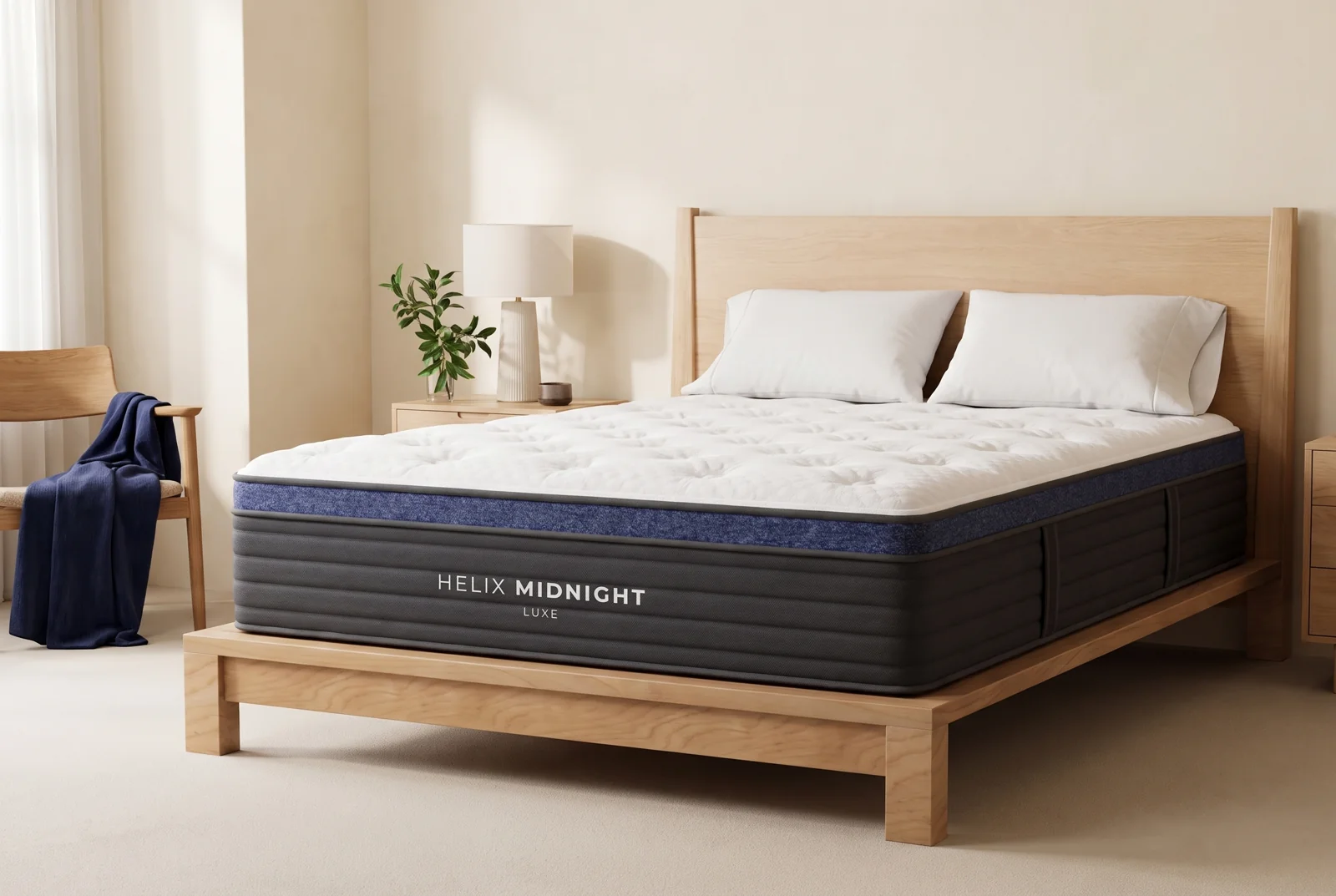
Quick Answer: Memory foam mattresses excel at pressure relief, motion isolation, and contouring support — making them ideal for side sleepers and couples on a budget. Hybrid mattresses combine coil support with foam comfort layers, offering better cooling, edge support, and responsiveness. Most sleepers who run warm or change positions frequently will feel the difference in a hybrid. Not sure which fits your sleep style? Keep reading — we break down every scenario.
This guide was developed by our in-store Sleep Expert team, drawing on years of hands-on mattress testing and customer consultations across multiple Los Angeles locations. All comparisons are based on construction characteristics and widely documented sleep research — not manufacturer marketing claims.
Memory foam — technically called viscoelastic polyurethane foam — was originally developed by NASA in the 1960s to improve seat cushioning and crash protection. It made its way into consumer mattresses in the 1990s and quickly became one of the most popular sleep surfaces in the country.
The defining characteristic of memory foam is how it responds to heat and pressure. When you lie down, your body warmth softens the foam, which then conforms closely to your shape. Remove that pressure, and the foam slowly returns to its original form — that's the "memory" in the name.
A typical memory foam mattress has two to four layers:
Higher-end memory foam beds may use plant-based or open-cell foam formulations that breathe better than traditional closed-cell designs. Some also layer in gel-infused foam or phase-change materials to address the classic heat-retention issue.
A hybrid mattress is exactly what the name implies: a combination of two mattress technologies. Specifically, it pairs an innerspring coil support system with one or more foam (or latex) comfort layers on top. The result is a mattress that aims to deliver the best of both worlds — the bounce and breathability of coils, plus the cushioning of foam.
A well-made hybrid mattress typically includes:
The coil count, coil gauge (thickness), and coil height all affect how a hybrid feels. Thicker gauges (lower numbers) are firmer; thinner gauges are softer and more conforming. Zoned coil systems — where the coils are grouped into different tension zones — add another layer of targeted support.
Here's how the two mattress types stack up across the factors that matter most to real sleepers.
| Category | Memory Foam | Hybrid | Winner |
|---|---|---|---|
| Pressure Relief | Excellent — conforms closely to body curves | Good — foam comfort layers provide relief, but less total contouring | Memory Foam |
| Motion Isolation | Excellent — foam absorbs movement effectively | Good — pocketed coils limit transfer, but some bounce remains | Memory Foam |
| Cooling & Airflow | Fair — traditional foam traps heat; infusions help but don't eliminate the issue | Excellent — coil system creates significant airflow through the mattress | Hybrid |
| Edge Support | Poor to Fair — foam compresses at edges; sitting on the perimeter feels soft | Good to Excellent — reinforced coils or perimeter foam provide a stable edge | Hybrid |
| Responsiveness / Bounce | Low — foam is slow to respond; moving around takes effort | High — coils respond instantly to position changes | Hybrid |
| Spinal Support | Good — especially for side sleepers when firmness is right | Very Good — coil system adapts well to varying body weights and positions | Hybrid (slight edge) |
| Durability | Good — high-density foam lasts 7–10 years; lower-density foam sags sooner | Very Good — quality coils maintain support longer; 8–12 years typical | Hybrid (slight edge) |
| Price Range | $400–$1,500+ (queen) | $800–$2,500+ (queen) | Memory Foam (more accessible) |
| Noise | Silent | Near-silent (pocketed coils don't squeak) | Tie |
| Best For | Side sleepers, light sleepers, budget-conscious shoppers, couples who prefer quiet | Hot sleepers, back/stomach sleepers, heavier sleepers, active couples | Depends on your needs |
Unmatched pressure relief. The slow-conforming feel of memory foam is genuinely therapeutic for people with hip, shoulder, or joint pain. The foam cradles pressure points rather than pushing back against them, which can make a real difference for side sleepers who spend hours on their shoulders and hips.
Superior motion isolation. If you share a bed with a restless partner, memory foam is hard to beat. The foam absorbs movement at the source rather than transmitting it across the mattress surface. Partners who go to bed or wake up at different times especially appreciate this quality.
No noise. Memory foam is completely silent. No squeaks, no springs — just quiet. This matters more than people expect, especially for light sleepers.
Lower starting price. A well-made memory foam mattress is typically more affordable than a comparable-quality hybrid. For shoppers on a strict budget, foam often offers the better value at the entry level.
Good for lighter-weight sleepers. People under 130 lbs. often find that hybrid coils feel too firm and don't compress enough for good pressure relief. Memory foam tends to provide better contouring for lighter bodies.
Heat retention is real. This is the most common complaint about memory foam, and for good reason. The dense, closed-cell structure of traditional memory foam traps body heat. Gel infusions, open-cell designs, and phase-change covers help — but they don't fully solve the problem. Hot sleepers consistently report sleeping warmer on foam than on hybrids.
Slow response can feel like "quicksand." If you move a lot during sleep, memory foam can feel like it's working against you. Changing positions requires effort, and some sleepers find the enveloping sensation claustrophobic rather than comforting.
Weak edge support. The perimeter of a memory foam mattress compresses more than the center, which makes sitting on the edge of the bed feel unstable. It also reduces the usable sleep surface — you may unconsciously avoid rolling too close to the edge.
Off-gassing smell. New memory foam mattresses often emit a chemical smell (VOCs from the manufacturing process) that can take several days to dissipate. It's generally harmless, but it's unpleasant for some people.
Dramatically better cooling. The coil support system at the center of a hybrid creates open space for air to circulate throughout the mattress. Heat moves through and dissipates rather than accumulating around your body. Even without added cooling technologies, a hybrid typically sleeps noticeably cooler than a comparable memory foam bed.
Better support for heavier sleepers. For sleepers over 230 lbs., memory foam can compress too deeply, creating a "hammock effect" that strains the lower back. Coil systems provide more consistent pushback across the sleep surface, which tends to support better spinal alignment for heavier body types.
Responsive feel for combination sleepers. If you switch positions during the night — back to side to stomach — a hybrid's coil system responds quickly to your movement. You don't have to fight the mattress to reposition, which means less sleep disruption overall.
Stronger edge support. Reinforced perimeter coils or dense foam edges give hybrid mattresses a much more stable edge than pure foam beds. The usable sleep surface extends closer to the actual edge, which matters in a shared bed where you need every inch.
Versatility across sleep positions. Because hybrids balance contouring comfort with responsive support, they tend to work well for a wider range of sleepers. This makes them a safer choice if you're unsure exactly what you need, or if your sleep position changes with the seasons or your activity level.
Higher price point. Quality hybrid mattresses cost more to manufacture — pocketed coil systems require more materials and labor than solid foam cores. Expect to spend more for a comparable quality level relative to memory foam.
Heavier and harder to move. A hybrid queen mattress typically weighs 80–120 lbs. Moving one into an apartment or up a staircase is a two-person job, and usually more involved than moving a foam mattress.
More motion transfer than memory foam. Pocketed coils reduce motion transfer significantly compared to traditional innerspring mattresses, but they don't absorb movement as completely as foam. If motion isolation is your top priority, memory foam still has the edge.
Potential for noise over time. Well-made hybrids with pocketed coils are quiet when new, but springs can develop small squeaks over years of use. This is uncommon in quality builds, but it's a consideration that doesn't apply to all-foam beds.
Side sleepers put concentrated pressure on their shoulders and hips — the two widest points of the body. Memory foam's deep contouring distributes that pressure more evenly, reducing the likelihood of waking up with a numb arm or sore shoulder. A medium or medium-soft memory foam or a hybrid with a plush comfort layer both work well. Check out our guide to the best mattresses for side sleepers for more detail.
Slight edge: Memory foam
Back sleepers need even support across the lumbar region to prevent the lower back from sinking too deeply or staying unsupported. A medium-firm to firm hybrid often provides the right combination of surface cushioning and underlying pushback. Memory foam works for back sleepers too, but firmness selection matters more — too soft and the hips sink, throwing the spine out of alignment.
Slight edge: Hybrid
Stomach sleeping puts the most pressure on the lower back, and soft mattresses make this worse by letting the hips sink below the spine's neutral line. Stomach sleepers typically need a firm surface. A firm hybrid provides the necessary pushback without the rigidity of an innerspring-only mattress. Very soft memory foam is generally not recommended for stomach sleepers. If you're dealing with back pain, our back pain mattress collection includes options evaluated for proper lumbar support.
Edge: Hybrid
If you move between positions throughout the night, responsiveness matters. Hybrid mattresses allow you to reposition with minimal effort, whereas memory foam requires more physical effort to change positions (especially when you've sunk into the foam). A medium-firm hybrid is the go-to recommendation for most combination sleepers.
Edge: Hybrid
Hot sleepers have a clear winner: hybrid mattresses.
The open coil structure in a hybrid allows air to move freely through the mattress core. Your body heat moves through the mattress rather than building up around you. Even a basic hybrid without gel infusions or phase-change materials will typically sleep cooler than a well-equipped memory foam mattress.
Memory foam's dense structure naturally retains heat. Manufacturers have worked hard to address this with gel infusions, copper or graphite particles, open-cell foam architectures, and phase-change material covers — and these improvements are real. But they reduce the heat problem rather than eliminate it. If you run warm, you'll still likely sleep cooler on a hybrid.
For sleepers who need serious thermal management, a hybrid paired with a breathable cover (like a Tencel or cotton-blend cover) and a moisture-wicking mattress protector is the most effective combination. You can explore options in our cooling mattress collection, and our best cooling mattress guide goes deeper on the top performers.
Couples have competing priorities: motion isolation (so you don't wake each other up), edge support (so you can use the full surface of the bed), and cooling (so neither of you overheats).
For motion isolation: Memory foam wins. If one partner wakes up early or tosses and turns frequently, a memory foam mattress minimizes how much of that movement reaches the other side.
For edge support: Hybrid wins. With a partner, you each gravitate toward your side of the bed. Strong edges let you sleep closer to your respective sides without feeling like you'll roll off.
For cooling: Hybrid wins. Two bodies produce more heat than one. A mattress that breathes well handles that extra thermal load better.
For different sleep positions: If one partner is a side sleeper and the other sleeps on their back or stomach, a medium-firm hybrid tends to be the best compromise — it offers enough cushioning for the side sleeper and enough support for the back or stomach sleeper.
The bottom line for couples: A well-constructed hybrid is the more versatile choice when two people with different needs share a mattress. But if motion isolation is the dominant concern — say, one partner works nights and the other mornings — memory foam's quiet stillness may outweigh the other trade-offs.
Mattress prices vary widely based on brand, materials, and where you buy. Here's a general picture for queen-size mattresses at retail:
| Tier | Memory Foam (Queen) | Hybrid (Queen) |
|---|---|---|
| Entry-level | $400–$700 | $700–$1,000 |
| Mid-range | $700–$1,200 | $1,000–$1,600 |
| Premium | $1,200–$2,000+ | $1,600–$3,000+ |
Memory foam's lower price floor is one of its genuine advantages. You can find a legitimate, durable memory foam mattress in the $500–$800 range — something that's harder to achieve with a quality hybrid.
That said, the hybrid premium often reflects real improvements in materials and durability. A quality hybrid with a well-built coil system may outlast an entry-level foam mattress by several years, which changes the long-term value equation. When comparing prices, factor in the expected lifespan: a $1,200 hybrid lasting 10–12 years has a lower cost per year than a $700 foam mattress lasting 6–7 years.
One more note: both mattress types are available across a wide range of firmness levels, so the "type" of mattress doesn't lock you into a particular feel. For more on navigating firmness options, our upcoming mattress firmness guide will walk through the full spectrum.
There's no universally better mattress type — only the one that fits your specific needs. Here's a practical decision framework:
Choose memory foam if:
Choose a hybrid if:
If you're still unsure, the most reliable advice is to test both in person. What feels comfortable for 60 seconds on a showroom floor isn't always what works for 8 hours of sleep — but it's far more useful data than any online quiz. If you'd like to explore all your options, our mattresses for side sleepers and hybrid selections are a good starting point, and you can always talk through your situation with a sleep advisor at any of our locations.
It depends on the cause and location of your back pain. Hybrids tend to perform better for lower back pain related to lack of support — the coil system maintains spinal alignment more consistently, especially for back and stomach sleepers. Memory foam can be better for localized pain at pressure points (hips, shoulders) because it distributes load more evenly. The most important factor is firmness relative to your sleep position and body weight, not the mattress type alone.
Quality hybrids tend to maintain their shape longer than entry-level memory foam mattresses. High-density foam (1.8 lbs/cubic ft or higher) in a memory foam mattress is more durable than low-density foam, which can develop body impressions within a few years. A well-built hybrid with a durable coil system and quality foam layers typically lasts 8–12 years. That said, foam quality matters in both types — a cheap foam comfort layer in a hybrid will compress over time just like it would in an all-foam bed.
Modern memory foam has improved significantly when it comes to temperature regulation. Gel-infused foams, copper-infused foams, open-cell foam structures, and phase-change material covers all help reduce heat retention. However, hybrids still have a structural advantage — their coil cores allow air to circulate through the mattress in a way dense foam simply cannot replicate. If you run hot, a memory foam mattress can work, but you'll typically need to prioritize models with multiple cooling technologies and accept that a hybrid would likely perform better.
Sleepers over 230 lbs. generally find that hybrid mattresses provide better long-term support. Memory foam can compress too deeply for heavier bodies, creating a "hammock" effect where the hips sink below the spine's neutral alignment. Hybrid coil systems provide consistent pushback across the sleep surface, and their durability under heavier loads tends to be better than foam alone. Look for hybrids with a coil gauge of 13–15 (lower gauge = thicker wire = more support) and a high-density base foam for best results.
Not in a significant way. Traditional innerspring mattresses are notorious for squeaking, but modern hybrids use individually pocketed coils that move independently and don't make the same interconnected noise. A new, well-made hybrid is essentially silent. Some noise can develop over years of use as the coils age, but this is uncommon in quality builds. Memory foam is completely silent at any age.
An innerspring mattress is built almost entirely around a coil support system with only a thin layer of padding on top — typically 1–2 inches of foam or fiber. A hybrid includes substantial comfort layers (usually 2–4 inches of memory foam, latex, or specialty foam) on top of the coil system. This thicker comfort layer is what gives hybrids their pressure relief and contouring ability. Innerspring mattresses tend to be firmer, bouncier, and less conforming. For a deeper look at innerspring construction, see our innerspring mattress collection.
Both memory foam and hybrid mattresses typically have a break-in period of 30–60 nights. Memory foam softens slightly as it acclimates to your body temperature and sleep patterns. Hybrid coils may feel slightly stiff initially and loosen up with regular use. Most manufacturers and sleep experts recommend giving a new mattress at least 30 nights before evaluating whether it's the right fit — your body also needs time to adjust from your previous sleep surface.
Natural latex offers a middle ground: it conforms to the body like foam but bounces back faster, sleeps cooler than memory foam, and is highly durable (often lasting 15+ years). It's a strong option for hot sleepers who want contouring without the heat trap of memory foam, and for those who prefer natural materials. The trade-off is price — natural latex mattresses tend to cost more than both foam and hybrid options. You can explore latex options in our latex mattress collection.
Choosing between memory foam and hybrid comes down to your specific body, sleep habits, and budget. Our team is available in-store to walk you through both types side by side — no pressure, just honest guidance.
Call or text: (323) 555-0100
Store hours: Monday–Saturday 10am–8pm | Sunday 11am–6pm
Find your nearest location
Buying guides and sleep advice — no email signup required.