
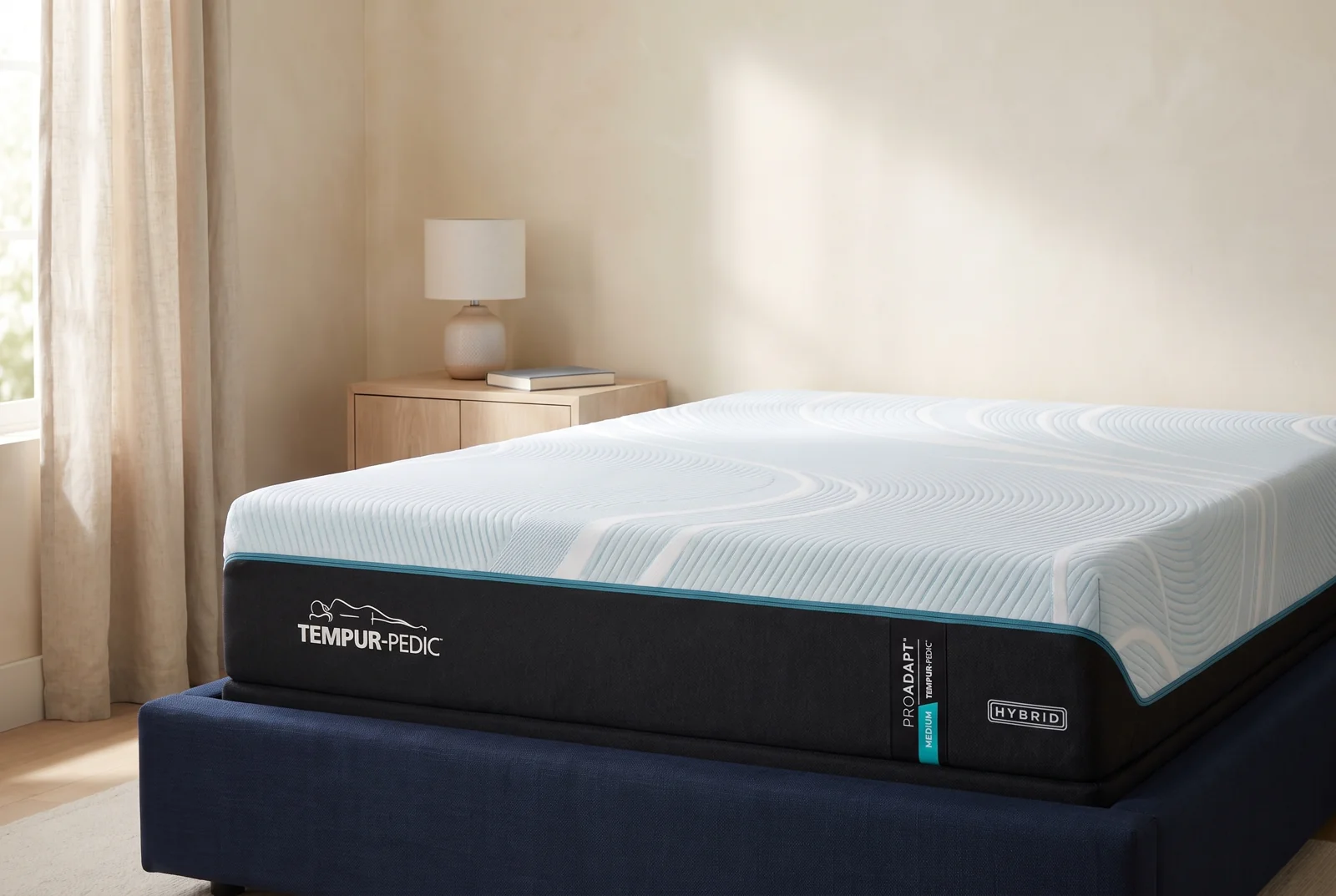
These two mattresses get cross-shopped constantly, and it is easy to see why: both are marketed as luxury, both promise pressure relief, and the price gap between them is large enough to make anyone hesitate. But they are built on completely different ideas about what a comfortable bed should do. Here is an honest look at both, and how to tell which one your body actually wants.
The Quick Verdict
Buy DreamCloud if you want a supportive hybrid with a plush quilted top at a mid-range price, you sleep on your back or stomach, you share the bed with a partner who likes some bounce, or you simply do not want to spend premium money on a mattress. Buy Tempur-Pedic if you want deep, slow, body-conforming pressure relief that no other foam quite replicates, you sleep on your side, you have hip or shoulder pain, or you want a bed that will still feel the same in year eight. The short version: DreamCloud is the better value, Tempur-Pedic is the better material.
Side-by-Side Comparison
| Feature | DreamCloud | Tempur-Pedic |
|---|---|---|
| Construction | Hybrid: pocketed coil support unit under foam comfort layers and a quilted cover | All-foam in most models, with proprietary TEMPUR material over a high-density foam base. Some hybrid models add pocketed coils |
| Feel and firmness range | Medium-firm, with a plush quilted surface over a clearly supportive base. Limited firmness choice | Broad range across the lineup, from soft to firm, with a distinctive slow-responding, sink-in feel |
| Best-suited sleeper | Back and stomach sleepers, combination sleepers, couples who dislike a sinking feel | Side sleepers, people with hip and shoulder pressure points, anyone who wants deep contouring |
| Motion isolation | Good. Pocketed coils move independently, though coils transfer more motion than solid foam | Excellent. Dense viscoelastic foam absorbs movement better than almost anything else on the market |
| Cooling | Strong. Coils create airflow through the core, which matters in a warm bedroom | Varies by model. Base models sleep warmer, cooling-focused models use phase-change covers and ventilated layers |
| Edge support | Very good. The perimeter coils hold up when you sit on the side | Fair to good on all-foam models, better on hybrid versions |
| Typical price tier | Mid-range | Premium to luxury |
| Trial and warranty | Long home trial and a lengthy warranty, standard for the bed-in-a-box category | Home trial and warranty terms vary by retailer and model. Check the specific terms at purchase |
| Where to buy | Online direct, shipped compressed in a box | Brand stores and authorized retailers, including LA Mattress Store showrooms |
DreamCloud on Its Own Terms
DreamCloud earns its reputation as a value pick. You get a genuine pocketed coil support system, which is the part of a mattress that does the structural work, wrapped in enough foam and a quilted cover to feel plush when you first lie down. That combination handles a lot of bodies well. Back sleepers get lumbar support without the mattress swallowing their hips. Stomach sleepers stay lifted rather than folding at the waist. Heavier sleepers generally do better on a coil core than on foam alone.
The airflow is a real advantage too. Coils leave open space inside the mattress, and open space moves heat away from you. In a Los Angeles bedroom without central air in September, that is the difference between sleeping through and waking up at 3 a.m.
Where it falls short: the firmness options are limited, so if your body wants something notably softer or firmer, you are out of luck. The comfort layers are competent rather than exceptional, which means side sleepers with sharp shoulder or hip pressure often find it does not give enough at those points. And because it ships compressed in a box, you are buying without lying on it first, betting a trial period against a bed you have never felt.
Tempur-Pedic on Its Own Terms
TEMPUR material is the reason this brand still commands premium pricing decades after it launched. It responds to heat and weight slowly, redistributing your body weight instead of pushing back against it. For a side sleeper whose shoulder digs into the mattress every night, or someone whose hip aches by morning, that difference is not subtle. It is often the whole reason they stop waking up sore.
Durability is the other argument. Dense viscoelastic foam holds its shape longer than cheaper foams, which soften and develop body impressions. The lineup also offers a wide range of feels, from soft models built for pressure relief to firmer ones for back and stomach sleepers, plus hybrid versions that add coils if you want more lift.
Where it falls short: the price is real. The slow-response feel also divides people sharply. Some sleepers love being cradled, others feel stuck and dislike having to push out of the mattress to change position. Base models can sleep warm, and the cooling-focused models that fix it cost more. If you flip positions all night, a responsive coil bed may simply suit you better regardless of quality.
How to Choose Between Them
If you are a side sleeper
Lean Tempur-Pedic. Side sleeping concentrates your weight on two narrow points, and deep contouring foam is the most reliable answer to that problem. A softer model in the lineup will let your shoulder settle in while keeping your spine straight.
If you sleep hot
Lean DreamCloud, or a cooling-focused Tempur-Pedic model if budget allows. Coils and airflow beat solid foam on heat almost every time, unless the foam bed is specifically engineered with cooling covers and ventilation.
If you share the bed
Tempur-Pedic wins on motion isolation. If your partner gets up at 5 a.m. and you would rather not know about it, dense foam is unmatched. DreamCloud is still good here, just not as good.
If you have back pain
It depends on the type. Aching from poor alignment usually improves on a supportive medium-firm hybrid like DreamCloud. Pain from pressure points and joint compression usually improves on conforming foam. Read our guide to sleeping with lower back pain before you decide, and browse mattresses for back pain to see what each style looks like in practice.
If budget is the deciding factor
DreamCloud, without much argument. You are getting a coil core and a plush top for mid-range money. Just be honest with yourself about whether you can live with one firmness option.
What We Would Actually Put You On
We do not carry DreamCloud. We do carry Tempur-Pedic, and we carry several online-native brands that go head to head with DreamCloud on price and construction, with one advantage DreamCloud cannot offer: you can lie on them before you buy.
If DreamCloud appeals to you, try Helix or Brooklyn Bedding in one of our five LA showrooms. Both are pocketed coil hybrids in the same price territory, and both offer far more firmness choice, so you can dial in the feel instead of hoping one option works. For a natural materials version of that hybrid feel, Birch is worth ten minutes on your back.
If the Tempur-Pedic feel is what you are after, compare the models directly. Tempur-Pedic mattresses vary a lot across the lineup, and the gap between a soft and a medium model is far bigger in person than on a spec sheet. Stearns & Foster is the other premium option we would show you if you want deep comfort over more traditional innerspring support.
Every mattress we sell comes with a free 120-night comfort guarantee, and same-day delivery ($100 upgrade, order by 4pm) is available across most of Los Angeles, so you are not waiting a week to sleep on your decision.
Frequently Asked Questions
Is DreamCloud a good mattress?
Yes, for the right sleeper. It is a well-built hybrid at a mid-range price, and it does a genuinely good job for back sleepers, stomach sleepers and couples. It is a weaker fit for side sleepers with significant shoulder or hip pressure, and for anyone who needs a firmness option outside its narrow range.
Are DreamCloud and Nectar the same company?
They share a parent company, which is why the two lines overlap in price and marketing. The mattresses themselves are built differently: DreamCloud is a hybrid with a coil core, while the core Nectar models are all-foam. If you are weighing those two specifically, our Nectar vs DreamCloud comparison goes deeper.
Where can I try a DreamCloud mattress?
DreamCloud sells primarily online, so in-person options are limited. If trying before buying matters to you, the practical move is to test comparable hybrids from brands that do have showroom presence. Helix and Brooklyn Bedding are the closest equivalents you can actually lie on in Los Angeles.
Do DreamCloud mattresses come in a box?
Yes. DreamCloud ships compressed and rolled, which is convenient for delivery and means you should let it expand for several hours before judging the feel. Tempur-Pedic models are generally delivered flat and uncompressed, so they feel correct from the first night.
Which lasts longer, DreamCloud or Tempur-Pedic?
Tempur-Pedic, in most cases. High-density viscoelastic foam resists body impressions better than the lower-density comfort foams used in value hybrids. DreamCloud's coil unit will likely outlast its comfort layers, which is the usual failure pattern for hybrids in this price bracket.
Try Both Feels Before You Commit
Reading about slow-response foam versus coil support only gets you so far. Ten minutes lying down tells you more than ten reviews. Take our sleep quiz to narrow the field, then visit any of our LA showrooms and put both feels side by side. Browse hybrid mattresses and memory foam mattresses to see what we have in stock right now.


