
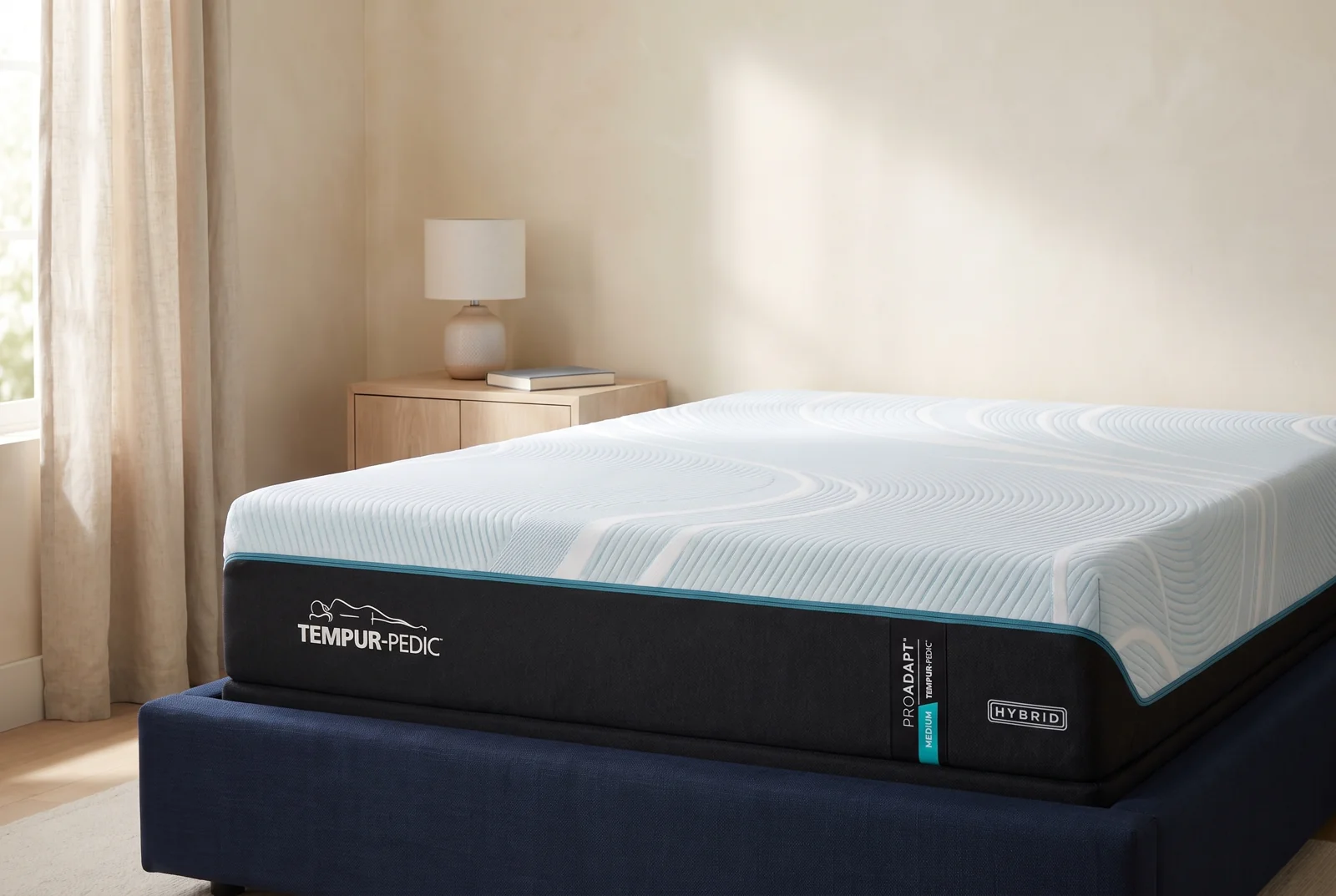
Both of these brands sell memory foam, and that is roughly where the similarity ends. Nectar is a bed-in-a-box brand built around affordable all-foam and hybrid mattresses that arrive compressed in a carton. Tempur-Pedic is a premium brand built around TEMPUR, a proprietary viscoelastic material that softens in response to body heat and weight, and it is sold almost entirely through showrooms. They compete for attention in search results far more than they compete for the same buyer.
Quick verdict
Buy Nectar if you want a soft to medium memory foam feel at an entry to mid-range price, you are shopping mostly on budget, and you are comfortable committing to a mattress you have never laid on. Buy Tempur-Pedic if you want slower, deeper contouring that stays consistent over many years, you have ongoing pressure point or lower back pain, and you want to test the exact model before you pay for it. In short: Nectar is the better value purchase, Tempur-Pedic is the better long-term one.
Nectar vs Tempur-Pedic at a glance
| Feature | Nectar | Tempur-Pedic |
|---|---|---|
| Construction | All-foam models with a memory foam comfort layer over a poly foam support core; hybrid models add pocketed coils | Proprietary TEMPUR comfort layers over a dense support base; hybrid models add pocketed coils |
| Feel and firmness range | Mostly medium to medium-firm, with a familiar sink-in memory foam response | Wider range from plush to firm, with a slower, denser, more melted-in response |
| Best-suited sleeper | Side and back sleepers of average build shopping on a budget | Side and back sleepers with pressure point pain, and heavier sleepers who need lasting support |
| Motion isolation | Very good on the all-foam models | Excellent, generally the strongest of any material category |
| Cooling | Adequate; cooling covers and gel help but foam still traps some heat | Better on the cooling-focused and hybrid lines, warmer on the classic all-foam models |
| Edge support | Soft edges on all-foam models, firmer on hybrids | Firmer overall, noticeably better on hybrid and higher-end models |
| Typical price tier | Entry-level to mid-range | Premium to luxury |
| Trial and warranty | Long at-home sleep trial and a lengthy limited warranty, standard for the bed-in-a-box category | Sleep trial plus a long limited warranty, terms vary by retailer and model |
| Where to buy | Online direct, plus a limited number of third-party retailers | Authorized showrooms and retailers, including LA Mattress Store |
Nectar on its own terms
Nectar did something genuinely useful for the market: it made a competent memory foam mattress cheap enough that replacing a worn-out bed stopped being a major financial decision. The classic all-foam build does the core job well. It cradles the shoulder and hip, it absorbs movement so a partner rolling over does not wake you, and it arrives at your door without a delivery appointment.
Where it falls short is longevity and heat. Lower-density comfort foams soften faster than premium ones, so the shape you feel in year one is often not the shape you feel in year five, particularly if you weigh more than average. The all-foam models also sleep warmer than a hybrid, which matters in a Los Angeles bedroom without central air. Edge support is the other honest weak point: sit on the perimeter of an all-foam Nectar and you will feel it compress under you.
Because Nectar is sold online, the real risk is fit rather than quality. You are guessing at firmness from a website, and the trial period only helps if you are willing to go through the return process.
Tempur-Pedic on its own terms
TEMPUR material behaves differently from ordinary memory foam. It responds more slowly, distributes weight more evenly, and holds its shape far longer, which is why Tempur-Pedic mattresses are so consistently recommended for people with hip, shoulder and lower back pain. If you have tried memory foam before and found it too shallow or too springy, this is the material that usually changes people's minds.
The two real drawbacks are price and feel preference. Tempur-Pedic sits in the premium tier and there is no way around that. And the deep hug is polarizing: combination sleepers who change position often sometimes describe it as harder to move on than a hybrid or latex bed. Tempur-Pedic addresses both heat and mobility on its cooling-focused and hybrid lines, but those sit at the top of the range.
If you want a fuller breakdown of the lineup, our Tempur-Pedic review covers the individual collections in more detail.
How to choose between them
If you are a side sleeper
Both work, but for different reasons. Nectar gives you enough give at the shoulder for far less money. Tempur-Pedic gives you deeper, more even pressure relief that tends to matter more if you already wake with a numb arm or a sore hip. Side sleepers with existing pain should lean Tempur-Pedic; side sleepers without it can be happy on either.
If you sleep hot
Skip the classic all-foam versions of both brands. A hybrid construction with pocketed coils moves air far better than any solid foam core, whatever the marketing says about gel infusion. Look at hybrid mattresses first, and check our guide to the best cooling mattresses before you decide.
If you share the bed
Motion isolation is a strength for both, so the deciding factor is usually edge support. If one of you sleeps near the perimeter, or you sit on the edge of the bed to get dressed, a hybrid from either brand is the safer pick.
If you have back pain
This is where the price gap is easiest to justify. Consistent, durable support is exactly what a painful back needs, and it is exactly what cheaper foams stop providing first. Start with medium-firm, and read our guide to choosing a mattress for back pain.
If budget is the constraint
Nectar wins outright, and there is no shame in that answer. Just be realistic that you are buying a mattress with a shorter useful life, and budget accordingly for a replacement sooner.
What we would actually put you on in Los Angeles
We do not carry Nectar, so we will not pretend to sell you one. What we can tell you is that the two things people like about Nectar, a friendly price and a bed-in-a-box format, are available from brands you can lie down on before you buy.
If you want the Nectar experience without the guesswork, come try Helix, Brooklyn Bedding or Birch. All three are online-native brands, all three ship compressed, and all three are on our showroom floors, which means you get the online-brand value with fifteen minutes of actually lying on it first. Birch in particular is the one to try if the reason you were considering Nectar is a natural or lower-chemical build.
If what you really want is the deep contouring that made you search for Tempur-Pedic in the first place, we carry the Tempur-Pedic lineup along with Stearns and Foster, which offers a similar premium feel with more of a traditional pillow-top character. Across five Los Angeles showrooms we also offer same-day delivery ($100 upgrade, order by 4pm) on in-stock models and a free 120-night comfort guarantee, so a wrong guess in the store is not a permanent one.
Frequently asked questions
Are Nectar mattresses good?
For the price, yes. A Nectar is a competent memory foam mattress that does the basics well: pressure relief on the side, strong motion isolation, and a low barrier to entry. It is not built to the same material standard as a premium mattress, so expect a shorter useful life, particularly if you are above average weight.
How long do Nectar mattresses last?
Budget all-foam mattresses generally hold their shape for around six to eight years before body impressions become noticeable, which is shorter than the ten years or more you can reasonably expect from higher-density premium foam or a well-built hybrid. See our guide to how long mattresses last for the full picture by material.
Where can I try a Nectar mattress?
Nectar is sold primarily online with limited retail placement, so in most cities there is no showroom option. If trying before buying matters to you, the practical move is to test a comparable bed-in-a-box brand in person instead. Helix, Brooklyn Bedding and Birch are all available to try in our showrooms.
Does a Nectar mattress come in a box?
Yes. Like most bed-in-a-box brands it ships compressed and rolled, and it needs time to decompress and off-gas after you unwrap it. Our guide to bed-in-a-box mattresses explains what to expect during that first week.
Is Tempur-Pedic worth the extra money?
It depends on what is driving the purchase. If you are replacing a worn-out guest room bed, no. If you have chronic pressure point pain, sleep on your side, or have been disappointed by cheaper foam softening under you, the durability and support consistency are what you are paying for, and most people who make that jump do not go back.
Test both feels before you decide
Reading about memory foam only gets you so far. Fifteen minutes on your actual sleeping position tells you more than any comparison article, including this one. Take our sleep quiz to narrow down firmness and material, then visit any of our Los Angeles showrooms to compare a premium TEMPUR feel against a bed-in-a-box hybrid side by side.


