
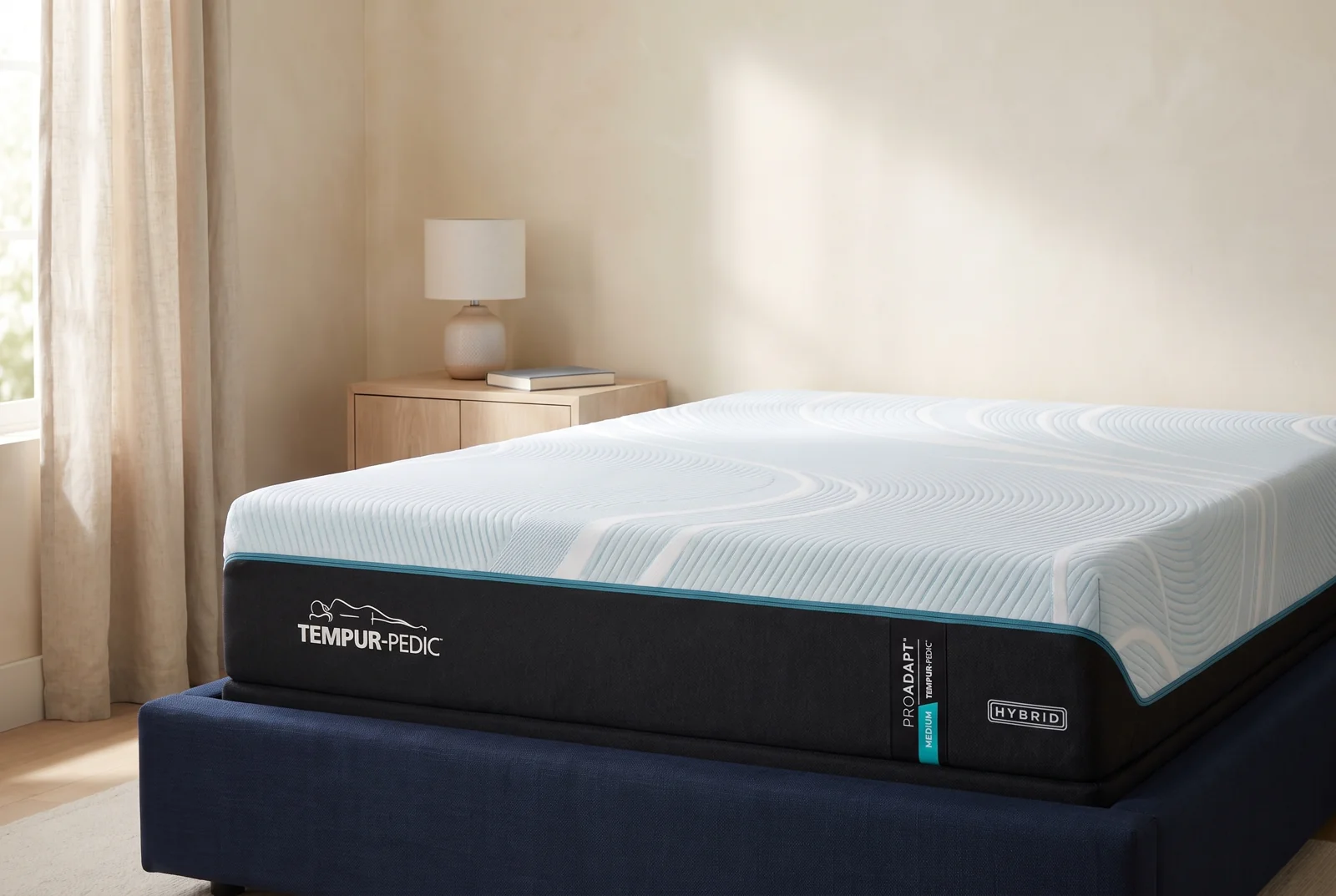
These two brands sit at opposite ends of the memory foam market. Casper helped build the bed-in-a-box category: order online, a compressed mattress arrives at your door, you cut the plastic and wait a few hours. Tempur-Pedic built its reputation on a proprietary viscoelastic foam that behaves differently from ordinary memory foam, sold mainly through mattress showrooms at a much higher price. Both can be the right answer. Which one depends on how much contouring you actually want and how much you are willing to spend to get it.
The Quick Verdict
Choose Casper if you want a familiar, moderately contouring all-foam or hybrid bed at an accessible price, you are comfortable buying online, and you would rather put the savings toward a base or bedding. Choose Tempur-Pedic if you want the deepest pressure relief available in a mattress, you sleep on your side or have persistent shoulder and hip pressure, and you plan to keep the bed for a decade or more. Tempur-Pedic costs considerably more and is worth it to a specific kind of sleeper, not to everyone.
Side-by-Side Comparison
| Factor | Casper | Tempur-Pedic |
|---|---|---|
| Construction | All-foam and hybrid models: polyfoam comfort layers, zoned support foam, pocketed coils in hybrid versions | Proprietary TEMPUR viscoelastic foam over high-density support foam; some models add pocketed coils |
| Feel and firmness range | Mostly medium to medium-firm, responsive rather than deeply sinking | Slow-responding and closely contouring; range from soft to firm depending on model |
| Best-suited sleeper | Combination sleepers, back sleepers, people who dislike a sinking feel | Side sleepers, people with pressure points at the shoulder and hip, those who want the bed to mold around them |
| Motion isolation | Good on all-foam models, slightly less on hybrids | Excellent, among the best available |
| Cooling | Generally sleeps neutral; hybrids move more air | Base models trap more heat; cooling-focused models add phase-change covers and airflow layers |
| Edge support | Moderate on all-foam, better on hybrid | Moderate on all-foam, better on hybrid models |
| Typical price tier | Entry-level to mid-range | Mid-range to premium |
| Trial and warranty | Sleep trial and multi-year warranty, terms set by the retailer or brand | Sleep trial and multi-year warranty, terms set by the retailer or brand |
| Where to buy | Primarily online and select retail partners | Widely available in mattress showrooms, including ours |
Check current trial and warranty terms with whoever sells you the bed. Those terms change, and the version quoted on a review site is often out of date.
Casper on Its Own Terms
Casper deserves credit for making mattress shopping less painful. Before bed-in-a-box, buying a mattress meant a showroom, a commissioned salesperson and a delivery date two weeks out. Casper compressed all of that into a box on your porch.
What it does well: the feel is approachable. Casper foams respond fairly quickly, so you do not get the stuck-in-quicksand sensation some people dislike about traditional memory foam. That makes it a reasonable pick for combination sleepers who change position through the night. Pricing is accessible, and the hybrid versions add coils for people who want a bit more lift and edge stability.
Where it falls short: the contouring is moderate by design. If your main complaint is a shoulder that aches in the morning or a hip that goes numb on your side, Casper's comfort layers may not cradle deeply enough to fix it. Foam durability in the entry-level models is also a real consideration. Softer comfort foams break down faster than dense ones, and a bed that feels great at month three can feel noticeably flatter by year five. And because Casper is sold mostly online, most buyers commit without lying on the mattress first.
Tempur-Pedic on Its Own Terms
TEMPUR material is not generic memory foam. It responds to body heat and weight and redistributes pressure more evenly than most foams, which is why it has held its position in the premium tier for decades. If you want to understand the material itself, we wrote a plain-language explainer on what TEMPUR material actually is.
What it does well: pressure relief and motion isolation are genuinely class-leading. Side sleepers who have bounced between medium-firm hybrids without finding relief often settle on a Tempur-Pedic and stop shopping. The foam density is high, which translates into a longer usable life than most all-foam competitors. If you sleep with a partner who gets up at 5am, a Tempur-Pedic is about as close to motion-proof as a mattress gets.
Where it falls short: price is the obvious one. Tempur-Pedic sits in the premium tier and there is no way around that. The slow-response feel is polarizing: some people love it, others feel trapped and hate rolling over. Base models also run warmer than a coil bed, which matters in Los Angeles from June through September. The cooling-focused models address this, but they cost more again. Stomach sleepers in particular often find the deep contouring pushes their hips out of line.
How to Choose Between Them
If you are a side sleeper
Tempur-Pedic has the clear edge. Side sleeping concentrates body weight on two narrow points, and deep contouring is what relieves that. If a Tempur-Pedic is out of budget, look at a softer hybrid with a generous comfort layer rather than a firmer all-foam bed. Our guide to the best mattresses for side sleepers covers what to look for.
If you sleep hot
Advantage Casper, at least on the base models. Coils move air in a way that solid foam blocks cannot, so a Casper hybrid will generally run cooler than an entry-level all-foam Tempur-Pedic. If you want Tempur-Pedic's feel and cooler sleep, you need one of the cooling-focused models with a phase-change cover, and you should budget accordingly.
If you share the bed
Tempur-Pedic wins on motion isolation. Casper's all-foam models are good here and its hybrids are merely fine. If one of you is a light sleeper and the other works irregular hours, that difference is worth real money.
If you have back pain
Neither brand is automatically the answer, and be skeptical of anyone who tells you otherwise. What matters is whether the mattress keeps your spine roughly neutral in your usual sleeping position. Back pain sufferers who need contouring around the lumbar curve often do better on Tempur-Pedic. Those who feel they sink too far and lose support often do better on a firmer hybrid, Casper's or anyone else's. This is the single best reason to lie on both for a full ten minutes before deciding.
If budget is the deciding factor
Casper. There is no honest way to argue a premium memory foam bed into an entry-level budget. That said, do not buy the cheapest all-foam bed you can find just because it ships in a box. A mid-range hybrid from a manufacturer with dense foams will usually outlast a bargain all-foam mattress by years. Our guide on how much a good mattress actually costs lays out realistic ranges.
What We Carry, and Why Trying It Matters
We stock Tempur-Pedic, so if the premium contouring feel is what you are after, you can lie on it in one of our five Los Angeles showrooms before you buy. We do not carry Casper. If you like the bed-in-a-box concept and want to try that category in person, we carry Helix and Brooklyn Bedding, both online-native brands with hybrid and all-foam models in a similar feel range and price tier, plus Birch if you want a natural latex and wool build instead of polyfoam. Being able to lie on a boxed mattress before committing is a genuine advantage, and it costs you nothing.
For premium contouring at the Tempur-Pedic tier, Stearns & Foster is the other option worth putting on your list. It is a hand-built innerspring and hybrid line with a more traditional plush-over-coils feel, so it suits people who want luxury without the slow-sink sensation. We compared the two directly in Tempur-Pedic vs Stearns & Foster.
If you want more background on the boxed-mattress category generally, including how it differs from traditional retail, see our complete bed-in-a-box guide.
Frequently Asked Questions
Is Tempur-Pedic worth it?
It is worth it if you need what it does best: deep pressure relief and near-total motion isolation, in a bed built to last well past the point where cheaper foam beds soften. It is not worth it if you are a stomach sleeper, run very hot, or dislike a slow-responding feel. Lie on one for ten full minutes in your normal sleeping position. That test answers the question better than any review.
How long does a Tempur-Pedic mattress last?
Longer than most all-foam mattresses, because the foam densities are higher. Expect a well-cared-for Tempur-Pedic to stay supportive for many years, which is a meaningful part of the value case at that price. Rotating it periodically and using a protector both help. Our guide on how long mattresses last breaks down realistic lifespans by type.
Can you flip a Tempur-Pedic mattress?
No. Tempur-Pedic mattresses are built one-sided, with comfort layers on top of a firmer support core. Flipping one puts you on the support base. You can and should rotate it head to foot to spread wear evenly.
Is Tempur-Pedic memory foam?
TEMPUR is a viscoelastic foam, which is the technical family memory foam belongs to, but the formulation is proprietary and behaves differently from generic memory foam. It responds more slowly, contours more closely and is denser than most memory foams used in mid-priced mattresses.
Which is better for back pain, Casper or Tempur-Pedic?
Neither is universally better. What helps back pain is spinal alignment in your actual sleeping position, not a brand name. Side sleepers with lumbar pain often prefer Tempur-Pedic's contouring; people who feel they sink too deep usually do better on a firmer hybrid. Test both, ideally with your own pillow.
Try Both Feels Before You Decide
Reading comparisons only gets you so far. Ten minutes lying on a mattress in your normal sleeping position tells you more than a week of research. Come test Tempur-Pedic alongside Helix, Brooklyn Bedding, Birch and Stearns & Foster at any of our five Los Angeles showrooms, or start with our sleep quiz to narrow the field first. Every mattress we sell comes with a free 120-night comfort guarantee, and free white-glove delivery on orders over $499. Browse the full Tempur-Pedic collection or all memory foam mattresses to see what is in stock.


