Free Local White-Glove Setup & Haul-Away on Orders Over $499Announcement 1 of 2
Explore Payment Options — View Financing DetailsAnnouncement 2 of 2
Lower back pain at night usually comes down to sleep position, pillow placement and mattress support. Here's how to set your bed up so your spine stays neutral until morning.
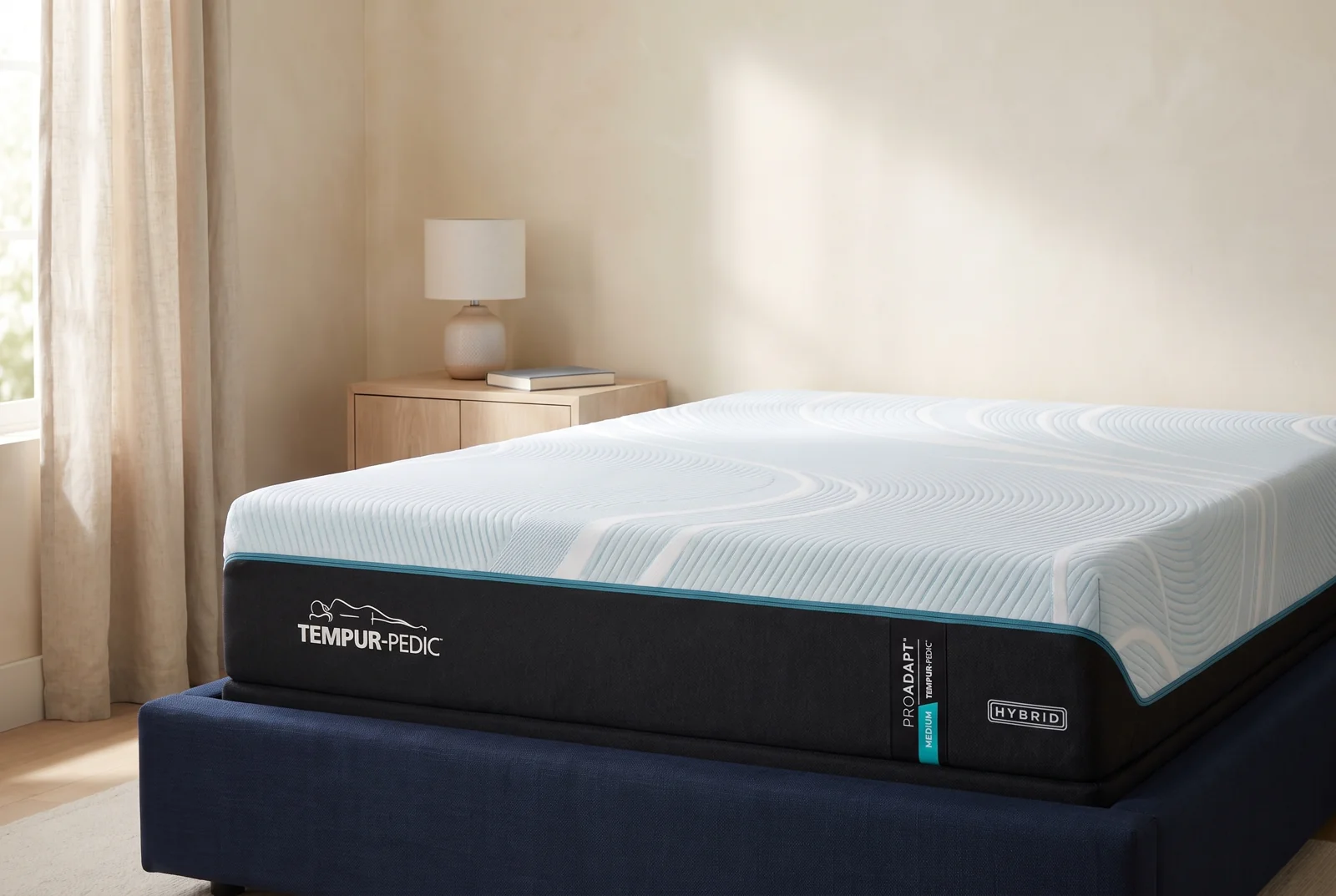
Tempur-Pedic TEMPUR-ProAdapt Medium HybridStyled product scene
If your lower back hurts most in the first ten minutes after you get out of bed, the problem usually isn't what you did during the day. It's the eight hours you just spent in one position. Sleep is the longest single stretch your spine holds a shape, and if that shape pulls your pelvis out of alignment, you feel it the moment you stand up.
The good news is that this is one of the more fixable sleep problems. Most of it comes down to three things: how you position your body, where you put a pillow, and whether your mattress is actually holding your hips up. Here's how to work through each.
There's no single "correct" position, but there is a version of each position that's kinder to your lower back.
Side sleeping is the most common position, and it's generally friendly to the lower back — with one catch. When your top leg drops forward and down, it rotates your pelvis and twists the lumbar spine. A firm pillow between your knees stops that rotation and keeps your hips stacked.
Use something with enough density to hold its shape all night. A soft down pillow will flatten by 2am and stop doing the job. A dedicated knee pillow or a firm foam pillow works better.
Lying flat on your back leaves a gap under your lumbar curve, and your lower back muscles end up quietly working all night to bridge it. Slide a pillow under your knees and that gap closes — the slight knee bend tilts your pelvis into a more neutral position and lets the muscles switch off.
A rolled towel under the small of your back can help too, especially on a firmer mattress. Keep it thin; you want to fill the gap, not prop yourself into an arch.
Sleeping face-down forces your neck into rotation and lets your midsection sink, which extends the lumbar spine for hours. If you can't break the habit, put a thin pillow under your hips and pelvis to reduce the sag, and use the flattest pillow you own under your head — or none at all.
If you want to transition away from stomach sleeping, try side sleeping with a body pillow to hug. It gives your arms and front something to rest against, which is usually what stomach sleepers are really after.
Position only gets you so far if the surface underneath is working against you. Two failure modes cause most lower back complaints:
The target is a surface that lets your hips and shoulders settle in just enough that your spine stays roughly as straight as it is when you're standing. For most people with lower back pain, that lands in the medium-firm range — supportive enough to hold the hips up, with enough top-layer give to avoid pressure points.
A quick test: lie on your side in your normal position and have someone look at you from behind. If your spine dips or arches noticeably rather than running roughly parallel to the mattress, the firmness is wrong for you.
If you're shopping, our mattresses for back pain collection is built around exactly this balance. And if your current bed is only a couple of years old and still structurally sound, a topper can buy you time — we cover that in Best Mattress Topper for Back Pain.
An adjustable base lets you raise your knees slightly without stacking pillows that shift during the night. A gentle bend at the hips and knees — sometimes called the zero-gravity position — takes load off the lumbar spine in a way that's hard to replicate on a flat bed.
You don't need a dramatic angle. A few degrees under the legs is often enough to notice a difference, and it's a setting you can dial in and leave alone.
Sleep setup can do a lot, but it isn't a treatment for everything. If your pain wakes you up repeatedly, radiates down a leg, comes with numbness or weakness, follows an injury, or hasn't improved after a few weeks of adjusting how you sleep, that's a conversation for a doctor or physical therapist rather than a mattress store.
On your side with a firm pillow between your knees, or on your back with a pillow under your knees. Both positions keep your pelvis from rotating or your lumbar curve from being unsupported. Avoid sleeping flat on your stomach if you can — it extends the lower back for hours at a time.
Side sleeping with knee support is the position most people find easiest to hold all night, because it keeps hips stacked and the spine neutral without needing much conscious effort. Back sleeping with a pillow under the knees is a close second and is often more comfortable for people whose pain sits low and central.
Yes — side sleeping is usually fine and often helpful. The key is preventing your top leg from falling forward, which twists the pelvis. Put a pillow between your knees, and make sure your mattress has enough give at the shoulder and hip that your waist isn't left hanging in a gap.
Indirectly, yes. Stacking pillows under your head pushes your neck and upper spine forward, and the rest of your back compensates. A single pillow that fills the gap between your head and the mattress — no more — is the goal. Extra pillows are better used under your knees or between them.
Some people find temporary relief on a very firm surface, usually because their current mattress is sagging and anything flat feels better by comparison. That's a signal your mattress needs replacing, not that the floor is the answer. A hard floor offers no contouring at the shoulder and hip, which creates its own pressure problems over time.
Back pain is personal enough that no article can tell you exactly which mattress will work for your body. What helps is lying on a few for more than thirty seconds. All five of our LA showrooms let you do exactly that, and every mattress comes with a free 120-night comfort guarantee so you can find out how it feels after a real month of sleep, not a five-minute test.
Not sure where to start? Take our sleep quiz and we'll narrow it down to a handful of beds worth trying.
Start with a mattress type that suits how you sleep, then compare the feel in person.
Prices for Queen · Choose options for other sizes


Est. $124.84/month for 6 months
Item-price payoff target · excludes taxes and fees.
Synchrony · No interest if paid in full within 6 months. Subject to credit approval.
Interest is charged from the purchase date if not paid in full in time. Minimum monthly payments are required and may not repay the balance in time.
This item price meets the 6-month deferred-interest threshold. We use the longest confirmed period available at this price. Avoiding interest requires paying the promotional balance in full before the deadline. Lender fees can affect total cost; this selection does not establish the lowest total borrowing cost.
This illustration divides the displayed price of $749.00 for one selected item by 6 months, rounding up to the next cent. It is not the lender’s required payment or billing schedule. Check the promotional deadline on your statement and pay the full promotional balance before it ends.
Taxes, delivery, recycling charges and any lender promotional fees are excluded. Fees may add to the total borrowing cost. Additional discounts can change plan eligibility and the amount financed. Confirm the final purchase amount and applicable terms with the store before arranging financing.
Credit approval, applicable account terms and purchase eligibility apply.
How Synchrony deferred interest works
Est. $158.17/month for 6 months
Item-price payoff target · excludes taxes and fees.
Synchrony · No interest if paid in full within 6 months. Subject to credit approval.
Interest is charged from the purchase date if not paid in full in time. Minimum monthly payments are required and may not repay the balance in time.
This item price meets the 6-month deferred-interest threshold. We use the longest confirmed period available at this price. Avoiding interest requires paying the promotional balance in full before the deadline. Lender fees can affect total cost; this selection does not establish the lowest total borrowing cost.
This illustration divides the displayed price of $949.00 for one selected item by 6 months, rounding up to the next cent. It is not the lender’s required payment or billing schedule. Check the promotional deadline on your statement and pay the full promotional balance before it ends.
Taxes, delivery, recycling charges and any lender promotional fees are excluded. Fees may add to the total borrowing cost. Additional discounts can change plan eligibility and the amount financed. Confirm the final purchase amount and applicable terms with the store before arranging financing.
Credit approval, applicable account terms and purchase eligibility apply.
How Synchrony deferred interest works
Est. $146.50/month for 6 months
Item-price payoff target · excludes taxes and fees.
Synchrony · No interest if paid in full within 6 months. Subject to credit approval.
Interest is charged from the purchase date if not paid in full in time. Minimum monthly payments are required and may not repay the balance in time.
This item price meets the 6-month deferred-interest threshold. We use the longest confirmed period available at this price. Avoiding interest requires paying the promotional balance in full before the deadline. Lender fees can affect total cost; this selection does not establish the lowest total borrowing cost.
This illustration divides the displayed price of $879.00 for one selected item by 6 months, rounding up to the next cent. It is not the lender’s required payment or billing schedule. Check the promotional deadline on your statement and pay the full promotional balance before it ends.
Taxes, delivery, recycling charges and any lender promotional fees are excluded. Fees may add to the total borrowing cost. Additional discounts can change plan eligibility and the amount financed. Confirm the final purchase amount and applicable terms with the store before arranging financing.
Credit approval, applicable account terms and purchase eligibility apply.
How Synchrony deferred interest works
Est. $91.63/month for 24 months
Item-price payoff target · excludes taxes and fees.
Synchrony · No interest if paid in full within 24 months. Subject to credit approval.
Interest is charged from the purchase date if not paid in full in time. Minimum monthly payments are required and may not repay the balance in time.
This item price meets the 24-month deferred-interest threshold. We use the longest confirmed period available at this price. Avoiding interest requires paying the promotional balance in full before the deadline. Lender fees can affect total cost; this selection does not establish the lowest total borrowing cost.
This illustration divides the displayed price of $2,199.00 for one selected item by 24 months, rounding up to the next cent. It is not the lender’s required payment or billing schedule. Check the promotional deadline on your statement and pay the full promotional balance before it ends.
Taxes, delivery, recycling charges and any lender promotional fees are excluded. Fees may add to the total borrowing cost. Additional discounts can change plan eligibility and the amount financed. Confirm the final purchase amount and applicable terms with the store before arranging financing.
Credit approval, applicable account terms and purchase eligibility apply.
How Synchrony deferred interest works
Est. $92.42/month for 12 months
Item-price payoff target · excludes taxes and fees.
Synchrony · No interest if paid in full within 12 months. Subject to credit approval.
Interest is charged from the purchase date if not paid in full in time. Minimum monthly payments are required and may not repay the balance in time.
This item price meets the 12-month deferred-interest threshold. We use the longest confirmed period available at this price. Avoiding interest requires paying the promotional balance in full before the deadline. Lender fees can affect total cost; this selection does not establish the lowest total borrowing cost.
This illustration divides the displayed price of $1,109.00 for one selected item by 12 months, rounding up to the next cent. It is not the lender’s required payment or billing schedule. Check the promotional deadline on your statement and pay the full promotional balance before it ends.
Taxes, delivery, recycling charges and any lender promotional fees are excluded. Fees may add to the total borrowing cost. Additional discounts can change plan eligibility and the amount financed. Confirm the final purchase amount and applicable terms with the store before arranging financing.
Credit approval, applicable account terms and purchase eligibility apply.
How Synchrony deferred interest worksBuying guides and sleep advice, no email signup required.