
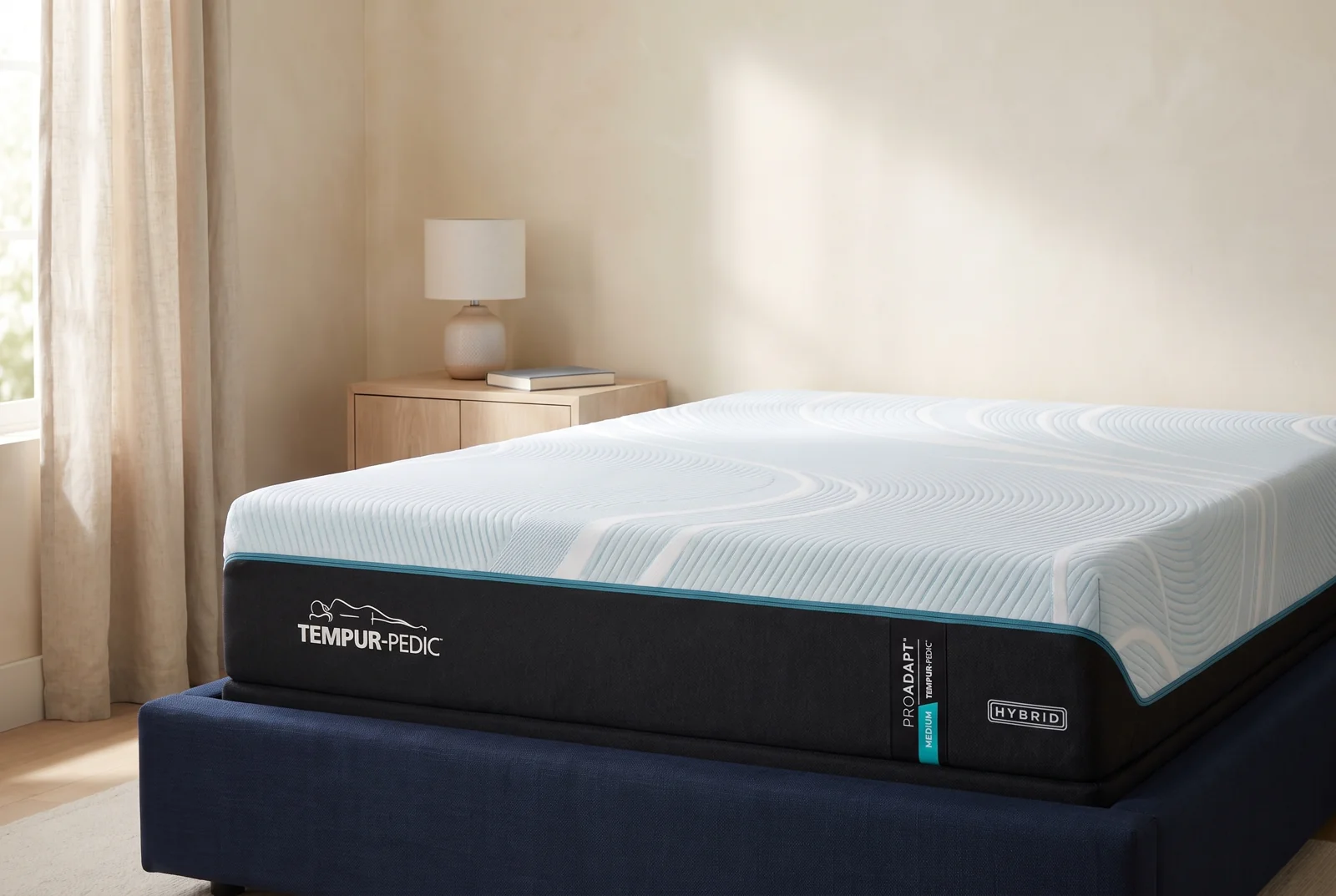
These two brands sit at opposite ends of the premium mattress world. Saatva built its reputation on a coil-on-coil innerspring with a euro pillow top, sold direct to consumers online. Tempur-Pedic built its on a proprietary viscoelastic foam, sold through retailers nationwide. Both are genuinely good. They just feel almost nothing alike, which is why choosing between them is less about which brand is better and more about which sensation you want under you every night.
The Quick Verdict
Choose Saatva if you want a classic supportive bed with lift and bounce, you get out of bed several times a night, you sleep hot, or you dislike the feeling of sinking into a mattress. The coil construction keeps you closer to the surface and moves air.
Choose Tempur-Pedic if you want deep contouring pressure relief, you share a bed with a restless partner, or you have hip and shoulder pain that a firmer surface aggravates. Its foam conforms more closely to your body than almost anything else on the market and it is exceptional at absorbing motion.
Side by Side Comparison
| Feature | Saatva | Tempur-Pedic |
|---|---|---|
| Construction | Innerspring and hybrid: a pocketed coil comfort layer over a steel support coil base, topped with a quilted euro pillow top. | All-foam: proprietary viscoelastic memory foam over a high-density support core. Hybrid versions add a pocketed coil base. |
| Feel | Buoyant and responsive. You rest on top of the mattress rather than in it. | Slow-responding and enveloping. The foam softens with body heat and molds around your shape. |
| Firmness range | Multiple firmness options within a single model line, plush soft through firm. | Firmness varies by collection rather than by option, soft to firm across the lineup. |
| Best suited sleeper | Back and combination sleepers, heavier sleepers who need lift, people who feel trapped by foam. | Side sleepers, people with pressure point pain, light sleepers with a restless partner. |
| Motion isolation | Good on pocketed coil models, though coils transfer some movement. | Excellent. Memory foam absorbs movement rather than passing it along. A category leader here. |
| Cooling | Strong. Open coil layers create airflow through the mattress core. | Varies by model. Dense foam retains more heat, offset with cooling covers and phase-change materials. |
| Edge support | Strong. Reinforced perimeter coils make sitting on the edge easy. | Moderate on all-foam models, stronger on the hybrid versions with a coil base. |
| Price tier | Mid-range to premium. | Premium to ultra-premium. |
| Trial and warranty | Home trial and a long warranty, sold direct. Confirm current terms before buying. | Home trial and a long warranty, terms set by retailer or brand. Confirm before buying. |
| Where to buy | Online direct, plus a few brand viewing rooms in major cities. | Mattress retailers nationwide, including our Los Angeles showrooms. |
Saatva on Its Own Terms
Saatva did something unusual for an online brand: it skipped the compressed bed-in-a-box format and ships full-size innerspring mattresses with white glove delivery. Because the mattress is never compressed, it can use tall steel coils and a real euro pillow top, which is why a Saatva feels closer to a luxury hotel bed than to a foam mattress.
Where it does well. Responsiveness is the headline. Moving around on a coil bed takes less effort than on dense memory foam, which matters if you change positions often or get up during the night. Edge support is genuinely good, so the full width of the bed is usable. And because air moves freely through a coil core, it runs cool without much engineering help. In a warm climate that counts.
Where it falls short. Pressure relief is the trade-off. Coil beds distribute weight rather than cradle it, so a dedicated side sleeper with a sharp hip or shoulder may not get the contouring they need. Motion isolation is decent but not in memory foam's league. And because Saatva sells direct, most buyers commit without lying on the mattress first.
Tempur-Pedic on Its Own Terms
Tempur material is not ordinary memory foam. It is a viscoelastic formulation that responds to body heat and weight, softening under the heavier parts of you and staying firmer under the lighter parts. The result is a mattress that holds your spine near neutral alignment without any single point taking concentrated pressure.
Where it does well. Pressure relief and motion isolation are the two things it does better than almost anything else. If your partner is up at 5 a.m. and you are not, foam this dense means you will often sleep through it. It is also durable in practice, holding its shape years longer than cheaper foams that develop body impressions.
Where it falls short. The sinking sensation divides people, and there is no way to know which camp you are in until you lie on one for ten minutes. Heat retention is the historic knock on dense foam: cooling covers help, but an all-foam bed will never move air the way a coil core does. Repositioning takes more effort, and the price sits at the top of the market.
How to Choose Between Them
If you are a side sleeper
Lean Tempur-Pedic. Your hip and shoulder need somewhere to go, and deep contouring foam handles that better than a coil surface. If you want the coil feel anyway, choose the plushest option available rather than fighting a firm surface. Our side sleeper collection is a good place to start.
If you sleep hot
Lean Saatva, or a Tempur-Pedic hybrid rather than an all-foam model. Physics favors the coil: open space in the core lets warm air escape. This matters more in Los Angeles than in Minnesota. A summer night in the Valley without air conditioning is a real test of a mattress.
If you share the bed
Lean Tempur-Pedic if either of you is a light sleeper or keeps different hours. Memory foam is the best motion isolator in the business. If you both sleep soundly through anything, this factor stops mattering and you can decide on feel alone.
If you have back pain
This does not resolve cleanly by brand, and be suspicious of anyone who says it does. Back pain responds to spinal alignment, and both constructions can deliver it at the right firmness. Back sleepers often do better on a medium-firm surface with good lift, which favors a coil bed. Side sleepers with pain often do better with contouring. Browse mattresses for back pain, then test in person.
If budget is the constraint
Saatva generally lands lower in the premium band than Tempur-Pedic. Compare comparable tiers rather than the top of one lineup against the bottom of the other, and factor in delivery and old mattress removal. A mattress you keep for a decade costs less per year than a cheaper one you replace in four.
What We Carry That Splits the Difference
To be straightforward: we stock Tempur-Pedic and we do not carry Saatva, so you can lie on one of these in our showrooms and not the other. That said, the Saatva feel does have equivalents.
If the coil-and-pillow-top sensation appeals to you, Stearns & Foster is the closest thing we carry: a traditional hand-built innerspring with a quilted top and strong edge support, in the same premium tier. Chattam & Wells sits in similar territory. If you want the online-brand experience but want to test it first, we stock Helix, Brooklyn Bedding and Birch, bed-in-a-box brands you can lie on before you commit instead of ordering blind. Birch in particular offers a latex hybrid with the bounce and cooling that draws people to Saatva in the first place.
If deep foam contouring is what you are after, Tempur-Pedic is on our floor across multiple collections and firmness levels, which is the only way to find out whether the sinking feel suits you.
Frequently Asked Questions
Is Saatva a good mattress?
By general consensus it is a well-built innerspring in the premium tier, particularly strong on edge support, cooling and responsiveness. Whether it is right for you depends on whether you prefer resting on top of a bed or sinking into one. The construction quality is not in dispute; the feel is a matter of preference.
Where can I try a Saatva mattress?
Saatva sells direct and operates a limited number of brand viewing rooms in select cities, so most buyers order without testing first. Comparable coil-and-pillow-top beds from Stearns & Foster and Chattam & Wells are available to test in our Los Angeles showrooms.
How long does a Tempur-Pedic mattress last?
Tempur material is among the more durable foams available and typically holds its performance longer than conventional memory foam. Replace any premium mattress when you notice persistent body impressions, wake up sore more often than you used to, or sleep noticeably better away from home. Rotating it head to foot a couple of times a year helps it wear evenly.
Are Tempur-Pedic mattresses worth it?
If you need best-in-class pressure relief or motion isolation, the value case is strong, because few products match it on those measures. If what you want is a supportive bouncy bed that sleeps cool, you can get that for less elsewhere and the premium is harder to justify. It is worth it for the right sleeper and overpriced for the wrong one.
Where are Saatva mattresses made?
Saatva assembles its mattresses in factories across the United States and ships from regional facilities, which is part of how it manages white glove delivery on uncompressed innerspring beds. Tempur-Pedic also manufactures domestically for the North American market.
Try Before You Commit
Ten minutes lying on a mattress tells you more than ten hours of reading about one. Contouring versus lift is a sensation, and sensations do not translate into text.
Visit any of our five Los Angeles showrooms to compare a Tempur-Pedic against a traditional coil build side by side, or start with our sleep quiz to narrow the field before you come in. Every mattress we sell is backed by our 120-night comfort guarantee, and same-day delivery ($100 upgrade, order by 4pm) is available across most of the LA area.
Related reading: Tempur-Pedic vs Stearns & Foster and Helix vs Tempur-Pedic.


