Free Local White-Glove Setup & Haul-Away on Orders Over $499Announcement 1 of 2
Explore Payment Options — View Financing DetailsAnnouncement 2 of 2
Gel memory foam is regular memory foam with a cooling agent added. Here's what the gel actually does, how much it helps, and when it's worth paying for.
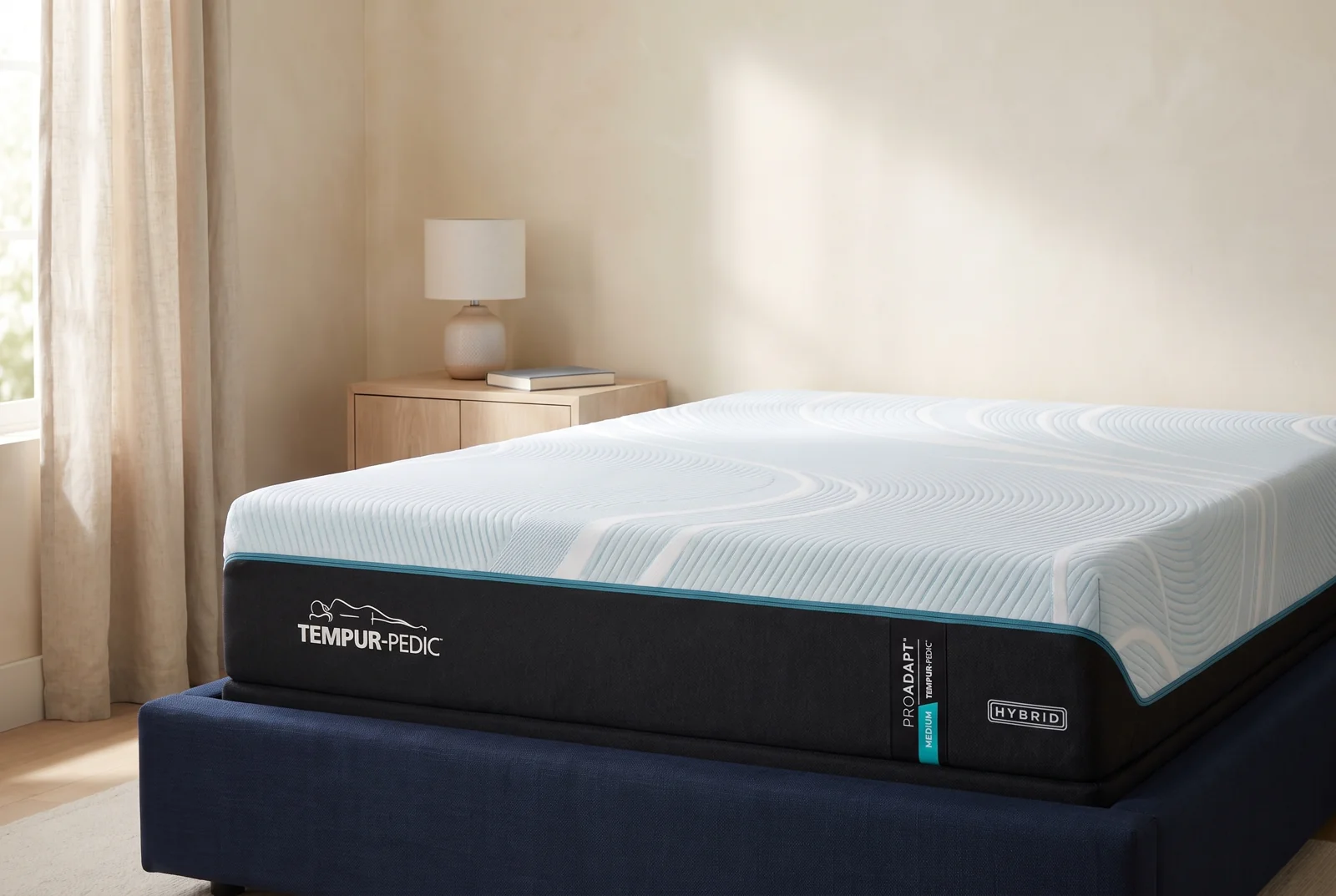
Tempur-Pedic TEMPUR-ProAdapt Medium HybridStyled product scene
Gel memory foam is ordinary memory foam with a cooling agent mixed into or layered onto it. That is the whole idea. Memory foam is very good at contouring to your body and historically not very good at staying cool, so manufacturers started adding gel to address the one obvious weakness of an otherwise excellent material.
The question worth asking is not "what is gel memory foam" — it is "how much does the gel actually help, and should I pay extra for it?" That depends on how the gel is used, and the honest answer is that it varies a great deal between mattresses. Here is what is actually going on inside the foam.
Memory foam is a viscoelastic polyurethane foam. Its defining trait is that it softens in response to body heat, which is exactly why it moulds so precisely to your shape — and also exactly why it holds warmth. The material is designed to absorb heat.
Gel is added to counteract that. Manufacturers do it in three main ways:
All three work on the same principle: gel has a higher thermal mass than foam, so it absorbs heat away from your body more readily and takes longer to warm up. Some formulations also use phase-change materials, which absorb heat as they shift state and feel genuinely cool to the touch for the first few minutes.
It buys you time before the bed warms up. This is the real, measurable benefit. A gel-infused foam takes longer to reach body temperature than the same foam without gel. For someone who tends to get too warm in the first hour of sleep, that can be the difference between falling asleep comfortably and kicking the covers off.
It keeps everything memory foam is good at. Adding gel does not compromise the contouring. You still get the pressure relief at the shoulder and hip that makes memory foam the go-to for side sleepers, and you still get the excellent motion isolation that makes it a good choice for couples.
It often comes with a slightly firmer, more supportive feel. Gel infusion tends to make the foam marginally denser, which some people find gives a more supportive surface with less of the sinking sensation that puts people off traditional memory foam.
Here is the part that most product pages leave out.
Gel absorbs heat; it does not remove it. Once the gel has reached your body temperature, it stops helping. It is a heat sink with finite capacity, not a cooling system. Over a full night, a gel foam mattress will end up close to where a plain foam mattress ends up. The benefit is front-loaded.
The amount of gel varies enormously. "Gel-infused" is a marketing term with no minimum threshold behind it. A mattress with a token amount of gel in a lower layer can carry the same label as one with a substantial gel layer directly under the cover. Position matters more than presence — gel four inches down does almost nothing for surface temperature.
It is not a fix for a genuinely hot sleeper. If you sleep hot enough that it disrupts your night, gel foam alone is unlikely to solve it. Airflow is what actually moves heat away, and solid foam has very little of it. A hybrid with a pocketed coil layer will almost always sleep cooler than any all-foam bed, gel or not. We go through the options in our cooling mattress guide.
That distinction matters in Los Angeles more than most places. A bedroom that sits at 78 degrees at midnight in September, in a building with no air conditioning, is not a problem gel beads can solve on their own.
If the price difference is small, take the gel version — there is no real downside to it. If it is a significant premium, spend that money on construction instead. A well-built hybrid with an open-cell comfort layer and coils underneath will out-cool a gel all-foam bed at the same price point almost every time.
The way to think about it: gel is a refinement, not a category. It makes a good memory foam mattress slightly better. It does not turn a warm mattress into a cool one. Our gel vs memory foam comparison goes into the feel differences in more detail.
Who it does not suit: sleepers who need to move easily during the night (any memory foam will feel slow), heavy sleepers who need more structural support than foam alone provides, and people who overheat severely — all three groups are better served by a hybrid.
It is viscoelastic polyurethane foam — the same base material as any memory foam — with a gel component added. That gel is typically a polymer or a phase-change material, introduced either as beads mixed through the foam, as a liquid swirled into it during manufacture, or as a separate layer laid on top.
Only the cooling agent. The contouring, the pressure relief and the motion isolation are the same because the underlying foam is the same. Gel foam simply takes longer to warm up to body temperature. Any claim that gel foam feels dramatically different should be treated with scepticism — in most cases the difference in feel comes from firmness and layer thickness, not the gel.
Yes, within limits. It is a genuine improvement on plain memory foam for anyone who sleeps slightly warm, and it costs the manufacturer relatively little, so the premium is usually modest. It is not a solution for serious overheating, and it is not a reason to choose an all-foam mattress over a hybrid if cooling is your main concern.
Cooler than plain memory foam, warmer than a hybrid or an innerspring. All solid foam restricts airflow, which is the main mechanism for moving heat away from the body. Gel slows the warm-up but does not eliminate it. If you already wake up sweating on your current bed, read our piece on whether memory foam makes you sweat before deciding.
Mattresses sold in the US must meet federal flammability standards, and foams certified to independent programmes such as CertiPUR-US are tested for restricted substances and low VOC emissions. New foam does give off an odour for the first few days — that is off-gassing, and airing the mattress in a ventilated room clears it. If chemical exposure is a concern for you, look for a certification on the specific mattress rather than a general claim on the brand.
Neither, on its own. What helps back pain is a support level that keeps your spine reasonably neutral — usually enough firmness under the hips to stop them dropping. Both plain and gel memory foam come in a full range of firmnesses, so the gel content is not the variable to optimise. Firmness and support are.
Roughly seven to ten years for a quality foam mattress, the same as any memory foam bed. Gel does not meaningfully change durability. What does affect it is foam density, sleeper weight, and whether the mattress sits on properly spaced support — slats more than about three inches apart will cause a foam mattress to sag long before its time.
Cooling is one of the hardest things to judge from a product description, because everyone's baseline is different. Fifteen minutes lying on a gel foam bed and a hybrid back to back will tell you more than any spec sheet.
You can do exactly that at any of our five Los Angeles showrooms. Browse our memory foam mattress range first if you want a sense of what is available, or start with our sleep quiz and we will narrow it to a short list. Every mattress comes with same-day LA delivery and a free 120-night comfort guarantee, so if it sleeps warmer than you expected at home, you are not stuck with it.
New to the material entirely? Our explainer on what memory foam is and how it works is the place to start.
Start with a mattress type that suits how you sleep, then compare the feel in person.
Prices for Queen · Choose options for other sizes


Est. $124.84/month for 6 months
Item-price payoff target · excludes taxes and fees.
Synchrony · No interest if paid in full within 6 months. Subject to credit approval.
Interest is charged from the purchase date if not paid in full in time. Minimum monthly payments are required and may not repay the balance in time.
This item price meets the 6-month deferred-interest threshold. We use the longest confirmed period available at this price. Avoiding interest requires paying the promotional balance in full before the deadline. Lender fees can affect total cost; this selection does not establish the lowest total borrowing cost.
This illustration divides the displayed price of $749.00 for one selected item by 6 months, rounding up to the next cent. It is not the lender’s required payment or billing schedule. Check the promotional deadline on your statement and pay the full promotional balance before it ends.
Taxes, delivery, recycling charges and any lender promotional fees are excluded. Fees may add to the total borrowing cost. Additional discounts can change plan eligibility and the amount financed. Confirm the final purchase amount and applicable terms with the store before arranging financing.
Credit approval, applicable account terms and purchase eligibility apply.
How Synchrony deferred interest works
Est. $158.17/month for 6 months
Item-price payoff target · excludes taxes and fees.
Synchrony · No interest if paid in full within 6 months. Subject to credit approval.
Interest is charged from the purchase date if not paid in full in time. Minimum monthly payments are required and may not repay the balance in time.
This item price meets the 6-month deferred-interest threshold. We use the longest confirmed period available at this price. Avoiding interest requires paying the promotional balance in full before the deadline. Lender fees can affect total cost; this selection does not establish the lowest total borrowing cost.
This illustration divides the displayed price of $949.00 for one selected item by 6 months, rounding up to the next cent. It is not the lender’s required payment or billing schedule. Check the promotional deadline on your statement and pay the full promotional balance before it ends.
Taxes, delivery, recycling charges and any lender promotional fees are excluded. Fees may add to the total borrowing cost. Additional discounts can change plan eligibility and the amount financed. Confirm the final purchase amount and applicable terms with the store before arranging financing.
Credit approval, applicable account terms and purchase eligibility apply.
How Synchrony deferred interest works
Est. $146.50/month for 6 months
Item-price payoff target · excludes taxes and fees.
Synchrony · No interest if paid in full within 6 months. Subject to credit approval.
Interest is charged from the purchase date if not paid in full in time. Minimum monthly payments are required and may not repay the balance in time.
This item price meets the 6-month deferred-interest threshold. We use the longest confirmed period available at this price. Avoiding interest requires paying the promotional balance in full before the deadline. Lender fees can affect total cost; this selection does not establish the lowest total borrowing cost.
This illustration divides the displayed price of $879.00 for one selected item by 6 months, rounding up to the next cent. It is not the lender’s required payment or billing schedule. Check the promotional deadline on your statement and pay the full promotional balance before it ends.
Taxes, delivery, recycling charges and any lender promotional fees are excluded. Fees may add to the total borrowing cost. Additional discounts can change plan eligibility and the amount financed. Confirm the final purchase amount and applicable terms with the store before arranging financing.
Credit approval, applicable account terms and purchase eligibility apply.
How Synchrony deferred interest works
Est. $91.63/month for 24 months
Item-price payoff target · excludes taxes and fees.
Synchrony · No interest if paid in full within 24 months. Subject to credit approval.
Interest is charged from the purchase date if not paid in full in time. Minimum monthly payments are required and may not repay the balance in time.
This item price meets the 24-month deferred-interest threshold. We use the longest confirmed period available at this price. Avoiding interest requires paying the promotional balance in full before the deadline. Lender fees can affect total cost; this selection does not establish the lowest total borrowing cost.
This illustration divides the displayed price of $2,199.00 for one selected item by 24 months, rounding up to the next cent. It is not the lender’s required payment or billing schedule. Check the promotional deadline on your statement and pay the full promotional balance before it ends.
Taxes, delivery, recycling charges and any lender promotional fees are excluded. Fees may add to the total borrowing cost. Additional discounts can change plan eligibility and the amount financed. Confirm the final purchase amount and applicable terms with the store before arranging financing.
Credit approval, applicable account terms and purchase eligibility apply.
How Synchrony deferred interest works
Est. $92.42/month for 12 months
Item-price payoff target · excludes taxes and fees.
Synchrony · No interest if paid in full within 12 months. Subject to credit approval.
Interest is charged from the purchase date if not paid in full in time. Minimum monthly payments are required and may not repay the balance in time.
This item price meets the 12-month deferred-interest threshold. We use the longest confirmed period available at this price. Avoiding interest requires paying the promotional balance in full before the deadline. Lender fees can affect total cost; this selection does not establish the lowest total borrowing cost.
This illustration divides the displayed price of $1,109.00 for one selected item by 12 months, rounding up to the next cent. It is not the lender’s required payment or billing schedule. Check the promotional deadline on your statement and pay the full promotional balance before it ends.
Taxes, delivery, recycling charges and any lender promotional fees are excluded. Fees may add to the total borrowing cost. Additional discounts can change plan eligibility and the amount financed. Confirm the final purchase amount and applicable terms with the store before arranging financing.
Credit approval, applicable account terms and purchase eligibility apply.
How Synchrony deferred interest worksBuying guides and sleep advice, no email signup required.