Free Local White-Glove Setup & Haul-Away on Orders Over $499Announcement 1 of 2
Explore Payment Options — View Financing DetailsAnnouncement 2 of 2
Memory foam is viscoelastic polyurethane that softens with body heat and moulds to your shape. Here is how it works, the four types you will actually meet, what it does well, where it falls down, and who should skip it.
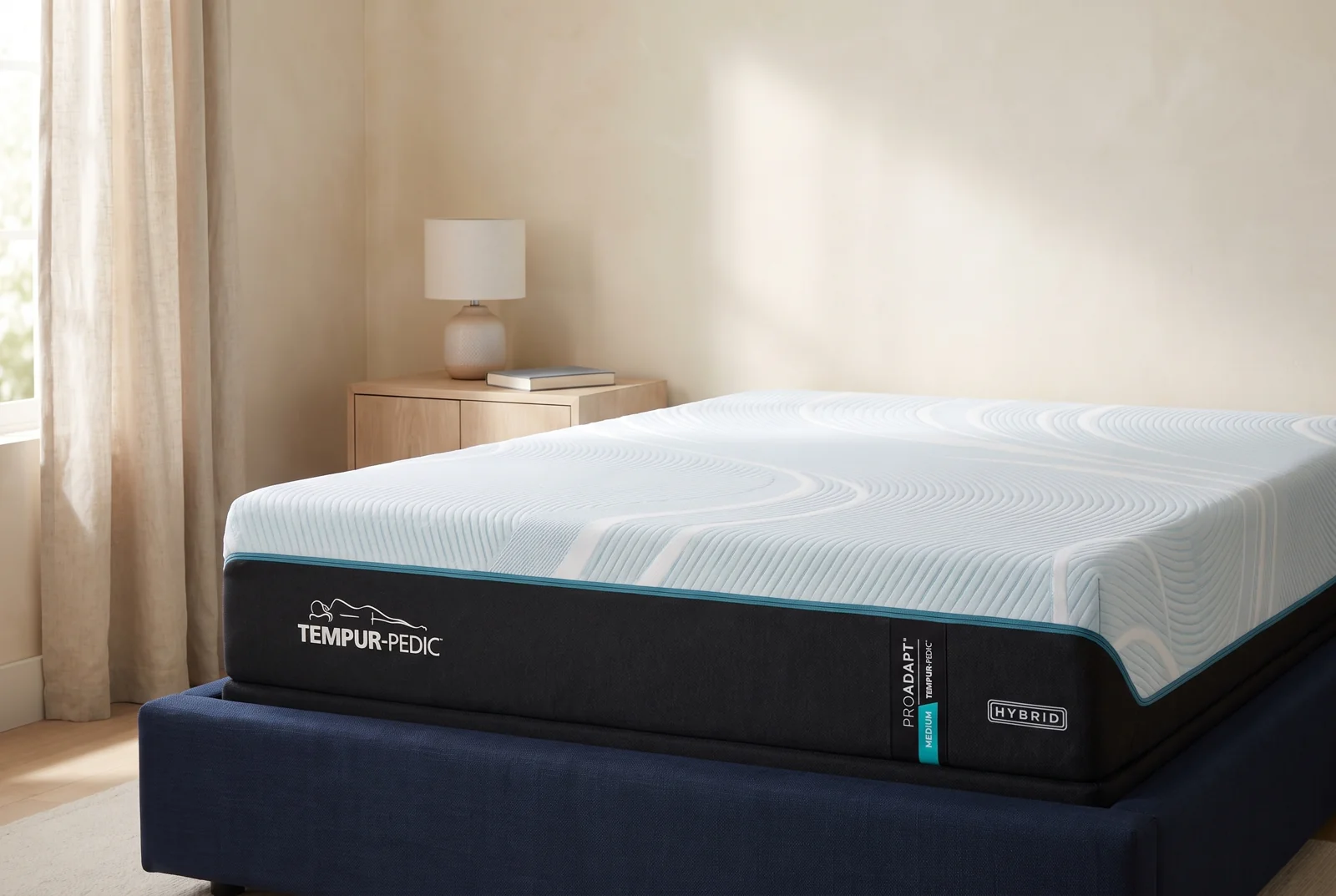
Tempur-Pedic TEMPUR-ProAdapt Medium HybridStyled product scene
Memory foam is a viscoelastic polyurethane foam that softens under body heat and moulds slowly to your shape, then returns to flat once you get up. That slow, cradling response is the whole reason people either love it or cannot stand it, and it is why the material dominates one half of the mattress market and is completely absent from the other.
"Memory foam" is also a broad label rather than a single product. Two mattresses can both be sold as memory foam and sleep nothing alike, because density, cell structure and what is layered above and below the foam matter more than the name on the tag.
Viscoelastic means the material has two properties at once. It is viscous, so it resists sudden movement and flows slowly under sustained pressure, and it is elastic, so it eventually returns to its original shape. Push a thumb into it and the dent stays visible for a few seconds before filling back in. Nothing else used in a mattress behaves quite like that.
The chemistry came out of NASA-funded aerospace research in the 1960s, aimed at cushioning pilots against g-forces. That formulation entered the public domain in the 1980s, and mattress manufacturers spent the following decade making it durable and comfortable enough to sleep on. It reached the consumer market in the 1990s and is now one of the two or three most common mattress materials worldwide.
Memory foam responds to pressure and temperature together, which is the part most descriptions skip.
That heat sensitivity explains several things people find puzzling: why a memory foam bed feels firmer on a cold morning, why the contouring feels so specific to your body, and why the material has a reputation for sleeping warm. It is designed to absorb heat.
The original closed-cell formulation. Dense, slow, and the best contouring of the four. It is also the warmest, because the closed cell structure limits airflow. Still common in comfort layers where deep pressure relief is the priority.
Gel beads, swirled gel or a gel sheet added to draw heat away from the surface. This is the most common version in mid-range and premium mattresses today. It genuinely delays the point at which the bed warms up, though it is a heat sink rather than a cooling system, so the benefit is front-loaded across the night. Our guide to gel memory foam covers how much difference it really makes, and our gel foam mattresses show the range.
Reformulated so air can move between the cells instead of being trapped. Sleeps cooler than traditional foam and usually feels slightly softer at first. Airflow, not gel, is the mechanism that actually moves heat away from a body, so open-cell construction tends to matter more than an infusion does.
Part of the petroleum-derived content replaced with plant-derived oils. Typically cooler, faster to respond and less prone to a strong new-mattress odour. It is not the same thing as a natural latex bed, which is a different material entirely.
Pressure relief. This is the defining strength and the reason to buy it. By spreading weight across the surface rather than concentrating it at the hips and shoulders, memory foam removes the pressure points that wake side sleepers at 3am with a numb arm or a sore hip.
Motion isolation. Foam absorbs movement instead of passing it along. If your partner gets up early or shifts constantly, you feel far less of it on memory foam than on any spring bed. For a lot of couples this alone settles the decision.
Silence. No coils, no helical lacing, nothing to squeak as it ages.
Durability, when density is right. High-density memory foam resists permanent body impressions well. Density, measured in pounds per cubic foot, predicts lifespan far better than thickness or price does.
Heat. The most common complaint, and a real one. Dense foam restricts airflow, and the material softens with warmth by design. Gel and open-cell formulations help substantially, but no all-foam mattress moves heat the way a coil unit does. In a Los Angeles bedroom that is still 78 degrees at midnight in September, this matters more than it does in most of the country.
The sinking feel. Slow response means the mattress takes a moment to catch up when you roll over. Some sleepers find that restful. Combination sleepers who change position all night often describe it as feeling stuck, and no amount of quality fixes it, because it is the material behaving as designed.
Edge support. All-foam mattresses compress at the perimeter, so the last few inches on each side are not usable sleeping surface and sitting on the edge to put on shoes feels unstable. A hybrid with a reinforced coil border solves this.
Off-gassing. New foam gives off a mild chemical odour for a few days as volatile organic compounds dissipate. Air the mattress in a ventilated room for a day or three before sleeping on it. Foams certified to independent programmes such as CertiPUR-US are tested for restricted substances and low emissions. Our piece on whether memory foam is toxic goes through the evidence.
Weight. Dense foam is heavy. Rotating or moving a queen memory foam mattress is a two-person job.
Good match: side sleepers who need shoulder and hip pressure relief, couples where one person moves a lot, anyone with chronic joint pain, light sleepers who want a silent bed, and people who like the sensation of being held rather than lifted.
Poor match: hot sleepers, combination sleepers who change position frequently, people who want to feel on top of the bed rather than in it, anyone who needs strong edge support, and heavier sleepers who compress foam deeply enough to lose support.
If most of that first list describes you but the heat worries you, the sensible answer is usually a hybrid: a pocketed coil core for airflow and edge support with a memory foam comfort layer on top. Our comparison of memory foam and hybrid mattresses works through the trade in detail.
| Feature | Memory foam | Latex | Hybrid | Innerspring |
|---|---|---|---|---|
| Pressure relief | Excellent | Very good | Good to very good | Moderate |
| Motion isolation | Excellent | Good | Very good | Poor |
| Cooling | Poor to good, depending on type | Very good | Very good | Good |
| Response speed | Slow | Fast | Moderate to fast | Fast |
| Edge support | Poor | Good | Very good | Very good |
| Durability | Very good | Excellent | Very good | Good |
Our complete mattress materials guide covers every option side by side, including latex and hybrid construction.
Give it a rigid, evenly supporting base with slats no more than about three inches apart, or a solid foundation. Wide slats let foam sag between them and will usually void the warranty. Do not flip it, since the layers are built in a fixed order with the support foam underneath, but rotate it head to foot a couple of times a year to spread wear. Use a breathable protector rather than a plastic one, which traps heat against the foam. Spot clean only, and never soak it, because saturated foam takes days to dry and can grow mould. Our guide to cleaning a memory foam mattress has the method.
Viscoelastic polyurethane foam. Polyurethane is the base polymer, and additives during manufacture give it the slow-recovery, heat-responsive behaviour that separates it from ordinary polyfoam. Gel versions add a polymer or phase-change material for heat absorption, and plant-based versions swap part of the petroleum content for plant-derived oils.
A mattress whose comfort layers, and often its whole build, are made of viscoelastic foam. All-foam versions stack memory foam over a firmer high-density support core. Hybrid versions put a memory foam comfort layer over a pocketed coil unit, which is the more common construction today because it keeps the contouring and adds airflow and edge support.
They are excellent at pressure relief and motion isolation and mediocre at cooling and edge support. Whether that trade works depends almost entirely on how you sleep. A side sleeper sharing a bed with a restless partner is close to the ideal candidate. A hot combination sleeper who likes a bouncy surface is close to the opposite.
Typically eight to ten years for a quality build, and closer to five or six for a low-density budget one. Foam density is the strongest predictor: denser foam resists the permanent impressions that eventually make a bed uncomfortable. Support underneath matters too, since a sagging foundation shortens the life of any mattress. See how long memory foam mattresses last for the warning signs.
Traditional closed-cell memory foam does. Gel-infused and open-cell versions are meaningfully cooler, and a hybrid with coils underneath is cooler still. If you already wake up sweating, do not rely on a gel infusion alone to fix it; airflow is what actually moves heat, and that means coils or a latex core.
Foam sold in the United States must meet federal flammability standards, and foams certified to programmes such as CertiPUR-US are independently tested for heavy metals, formaldehyde and certain flame retardants. The chemical smell on a new mattress is off-gassing, and it fades over days in a ventilated room. If chemical exposure is a concern, look for certification on the specific mattress rather than a general claim about the brand, or consider natural latex and organic cotton construction instead.
Ordinary polyfoam compresses and springs back immediately. Memory foam compresses slowly, holds the shape briefly and recovers slowly, and it softens with body heat while polyfoam does not. Memory foam is denser and better at pressure relief; polyfoam is bouncier, cheaper and used mostly as a support layer rather than a comfort layer.
It can be, particularly when the pain comes from hip and shoulder pressure while side sleeping. Back sleepers with lower back pain usually do better on a medium-firm surface with enough support to stop the hips dropping, which sometimes means a hybrid rather than all foam. Firmness and support matter more here than the material does, and persistent pain is worth discussing with a doctor rather than solving with bedding alone.
The slow-sink sensation of memory foam is something people react to immediately, and no description substitutes for ten minutes lying down. Come compare a traditional foam bed, a gel foam bed and a hybrid back to back at any of our five Los Angeles showrooms, in the position you actually sleep in. Browse our memory foam mattresses and hybrid collection first if you want a sense of the range, or take our two-minute sleep quiz for a firmness recommendation. Same-day delivery is available on in-stock models across most of the metro, and every mattress comes with our free 120-night comfort guarantee.
Start with a mattress type that suits how you sleep, then compare the feel in person.
Prices for Queen · Choose options for other sizes


Est. $124.84/month for 6 months
Item-price payoff target · excludes taxes and fees.
Synchrony · No interest if paid in full within 6 months. Subject to credit approval.
Interest is charged from the purchase date if not paid in full in time. Minimum monthly payments are required and may not repay the balance in time.
This item price meets the 6-month deferred-interest threshold. We use the longest confirmed period available at this price. Avoiding interest requires paying the promotional balance in full before the deadline. Lender fees can affect total cost; this selection does not establish the lowest total borrowing cost.
This illustration divides the displayed price of $749.00 for one selected item by 6 months, rounding up to the next cent. It is not the lender’s required payment or billing schedule. Check the promotional deadline on your statement and pay the full promotional balance before it ends.
Taxes, delivery, recycling charges and any lender promotional fees are excluded. Fees may add to the total borrowing cost. Additional discounts can change plan eligibility and the amount financed. Confirm the final purchase amount and applicable terms with the store before arranging financing.
Credit approval, applicable account terms and purchase eligibility apply.
How Synchrony deferred interest works
Est. $158.17/month for 6 months
Item-price payoff target · excludes taxes and fees.
Synchrony · No interest if paid in full within 6 months. Subject to credit approval.
Interest is charged from the purchase date if not paid in full in time. Minimum monthly payments are required and may not repay the balance in time.
This item price meets the 6-month deferred-interest threshold. We use the longest confirmed period available at this price. Avoiding interest requires paying the promotional balance in full before the deadline. Lender fees can affect total cost; this selection does not establish the lowest total borrowing cost.
This illustration divides the displayed price of $949.00 for one selected item by 6 months, rounding up to the next cent. It is not the lender’s required payment or billing schedule. Check the promotional deadline on your statement and pay the full promotional balance before it ends.
Taxes, delivery, recycling charges and any lender promotional fees are excluded. Fees may add to the total borrowing cost. Additional discounts can change plan eligibility and the amount financed. Confirm the final purchase amount and applicable terms with the store before arranging financing.
Credit approval, applicable account terms and purchase eligibility apply.
How Synchrony deferred interest works
Est. $146.50/month for 6 months
Item-price payoff target · excludes taxes and fees.
Synchrony · No interest if paid in full within 6 months. Subject to credit approval.
Interest is charged from the purchase date if not paid in full in time. Minimum monthly payments are required and may not repay the balance in time.
This item price meets the 6-month deferred-interest threshold. We use the longest confirmed period available at this price. Avoiding interest requires paying the promotional balance in full before the deadline. Lender fees can affect total cost; this selection does not establish the lowest total borrowing cost.
This illustration divides the displayed price of $879.00 for one selected item by 6 months, rounding up to the next cent. It is not the lender’s required payment or billing schedule. Check the promotional deadline on your statement and pay the full promotional balance before it ends.
Taxes, delivery, recycling charges and any lender promotional fees are excluded. Fees may add to the total borrowing cost. Additional discounts can change plan eligibility and the amount financed. Confirm the final purchase amount and applicable terms with the store before arranging financing.
Credit approval, applicable account terms and purchase eligibility apply.
How Synchrony deferred interest works
Est. $91.63/month for 24 months
Item-price payoff target · excludes taxes and fees.
Synchrony · No interest if paid in full within 24 months. Subject to credit approval.
Interest is charged from the purchase date if not paid in full in time. Minimum monthly payments are required and may not repay the balance in time.
This item price meets the 24-month deferred-interest threshold. We use the longest confirmed period available at this price. Avoiding interest requires paying the promotional balance in full before the deadline. Lender fees can affect total cost; this selection does not establish the lowest total borrowing cost.
This illustration divides the displayed price of $2,199.00 for one selected item by 24 months, rounding up to the next cent. It is not the lender’s required payment or billing schedule. Check the promotional deadline on your statement and pay the full promotional balance before it ends.
Taxes, delivery, recycling charges and any lender promotional fees are excluded. Fees may add to the total borrowing cost. Additional discounts can change plan eligibility and the amount financed. Confirm the final purchase amount and applicable terms with the store before arranging financing.
Credit approval, applicable account terms and purchase eligibility apply.
How Synchrony deferred interest works
Est. $92.42/month for 12 months
Item-price payoff target · excludes taxes and fees.
Synchrony · No interest if paid in full within 12 months. Subject to credit approval.
Interest is charged from the purchase date if not paid in full in time. Minimum monthly payments are required and may not repay the balance in time.
This item price meets the 12-month deferred-interest threshold. We use the longest confirmed period available at this price. Avoiding interest requires paying the promotional balance in full before the deadline. Lender fees can affect total cost; this selection does not establish the lowest total borrowing cost.
This illustration divides the displayed price of $1,109.00 for one selected item by 12 months, rounding up to the next cent. It is not the lender’s required payment or billing schedule. Check the promotional deadline on your statement and pay the full promotional balance before it ends.
Taxes, delivery, recycling charges and any lender promotional fees are excluded. Fees may add to the total borrowing cost. Additional discounts can change plan eligibility and the amount financed. Confirm the final purchase amount and applicable terms with the store before arranging financing.
Credit approval, applicable account terms and purchase eligibility apply.
How Synchrony deferred interest worksBuying guides and sleep advice, no email signup required.