Free Local White-Glove Setup & Haul-Away on Orders Over $499Announcement 1 of 2
Explore Payment Options — View Financing DetailsAnnouncement 2 of 2
A hybrid mattress puts real foam or latex comfort layers over a pocketed coil support core. Here is how they are built, what they genuinely do well, the drawbacks nobody advertises, and who should buy one.
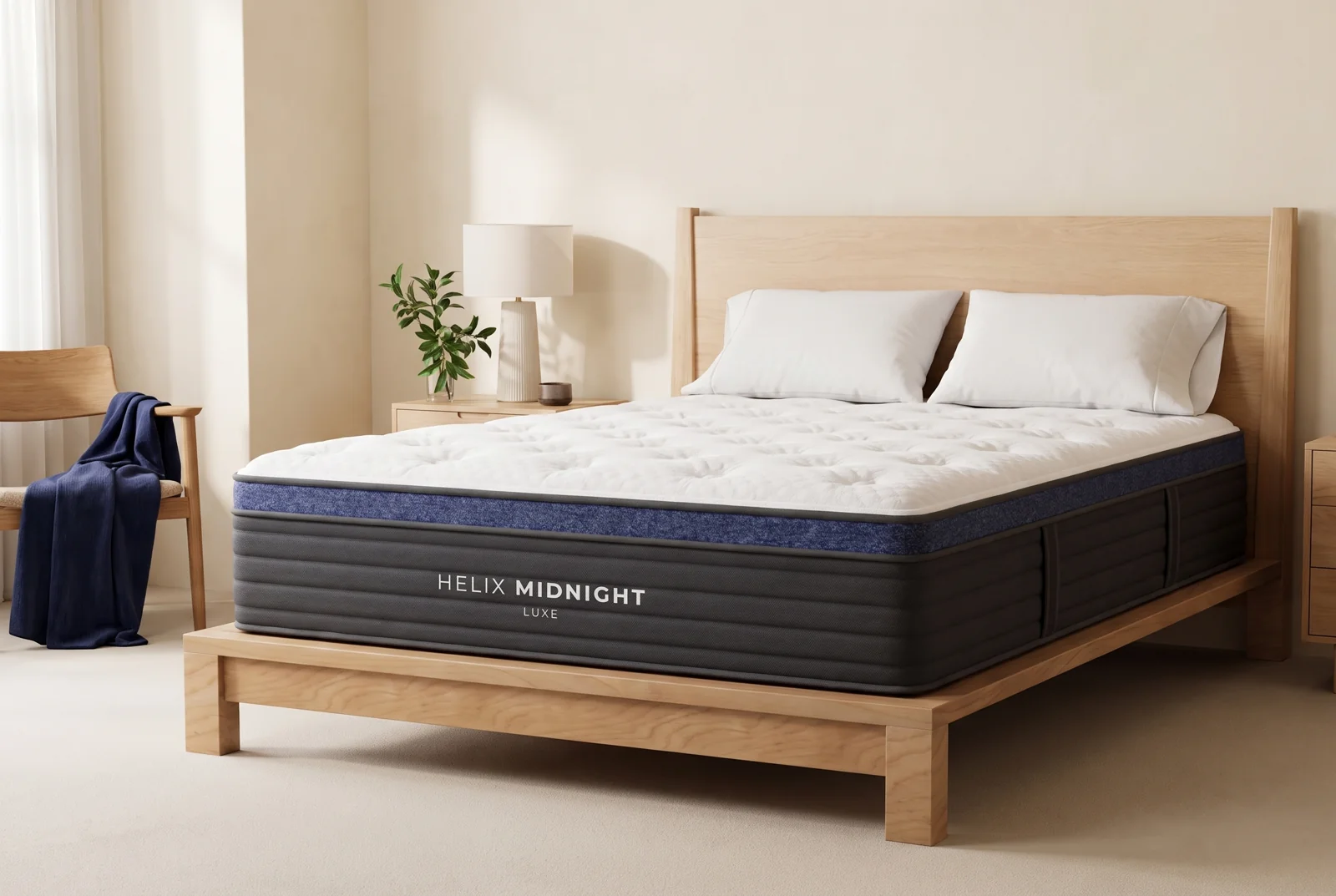
Helix Midnight LuxeStyled product scene
A hybrid mattress combines foam comfort layers with a coil support system underneath. The idea is to get the pressure relief of foam and the bounce and airflow of springs, without the drawbacks of either material used on its own.
Hybrids are the most popular mattress construction sold today, and the popularity is mostly deserved. They are not right for everyone, though, and the word gets stretched to cover beds that barely qualify. This guide explains what actually makes a mattress a hybrid, how one feels, what the real trade-offs are, and who should buy a different type instead.
A mattress qualifies as a hybrid when it combines at least two to three inches of foam or latex comfort layers on top of a pocketed coil support core. Both systems have to be substantial enough to change how the bed feels. A cheap innerspring with half an inch of quilting foam is not a hybrid, whatever the tag says.
The coil type matters as much as the foam. True hybrids use pocketed coils, meaning each spring is wrapped in its own fabric sleeve and moves independently of its neighbours. Older interconnected designs such as Bonnell and continuous coil work as a single connected grid, which is why they transmit motion across the bed. If you want the distinction in detail, see what a pocket spring is and what a Bonnell spring is.
Most hybrids stack the same five layers, top to bottom:
The two specs that decide quality are the density of the comfort foam and the gauge of the coil wire. Neither one usually appears on the product page, which tells you something in itself. Our guide to high density foam explains why density predicts how long a mattress lasts far better than any firmness rating does.
The foam contours to your hips, shoulders and lower back where pressure builds. The coils underneath stop you sinking past the point where your spine stays neutral. That combination is why hybrids suit a wider range of bodies and sleep positions than any single-material mattress.
A coil layer is mostly open space, so air moves through it. All-foam mattresses surround more of your body and insulate. If you sleep warm, this is the single biggest structural reason to choose a hybrid over a memory foam mattress.
Deep memory foam can feel like sleeping in the mattress rather than on it, and getting out takes effort. Coils push back, which makes rolling over and getting up noticeably easier. Combination sleepers feel this difference immediately.
Coil perimeters hold up better than foam ones. That matters if you sit on the edge of the bed to dress, sleep near the edge, or share a bed and need the full width to be usable. Our guide to mattress edge support explains what reinforcement to ask about.
Because hybrids balance give and support, side, back and combination sleepers all tend to do well on a correctly specified one. That versatility is useful when two people with different sleep styles share the bed.
The coil core adds significant weight. A queen hybrid commonly runs 80 to 120 pounds depending on construction. Rotating it is a two-person job, and getting it up a narrow staircase is worth thinking about before delivery day.
More materials and more complex assembly cost more. Budget hybrids exist, but coil gauge and foam density both drop sharply at the low end, and a cheap hybrid is often worse value than a well-made all-foam bed at the same price.
Pocketed coils are far better than interconnected ones, but dense foam still wins outright. If you share a bed with someone who gets up at 5 a.m. and you would rather not know about it, all-foam is the stronger choice.
Well-made pocketed coil units stay quiet for years. Cheaper ones develop squeaks as the coil sleeves wear and steel starts contacting steel. A sagging or uneven foundation accelerates this considerably.
There is no industry standard for what medium means. Two hybrids both labelled medium-firm can feel a full step apart. This is the main practical argument for lying on the bed rather than buying from a spec sheet.
A hybrid is a strong fit if you:
Look at something else if you:
| Feature | Hybrid | Memory foam | Innerspring |
|---|---|---|---|
| Pressure relief | Good | Excellent | Fair |
| Airflow and cooling | Good | Poor to fair | Excellent |
| Motion isolation | Good with pocketed coils | Excellent | Poor to fair |
| Bounce and responsiveness | Good | Poor | Excellent |
| Edge support | Good | Fair | Good |
| Weight | Heavy | Medium | Heavy |
| Typical price tier | Mid to premium | Entry to premium | Entry to mid |
| Typical lifespan | 8 to 12 years | 7 to 10 years | 5 to 8 years |
For a direct head-to-head, read memory foam vs hybrid and hybrid vs innerspring.
Hybrid feel varies more between brands than any other construction, which makes this the mattress type where showroom time pays off most. We carry hybrids across the range at our five Los Angeles showrooms: Helix and Brooklyn Bedding in the accessible tier, both online-native brands you can actually lie on here rather than ordering blind; Birch if you want natural latex over coils; Stearns & Foster and Chattam & Wells at the luxury end; and Spring Air, Restonic, Southerland and Diamond covering the mid-range.
One Los Angeles-specific note: airflow matters more here than the national averages suggest. Plenty of bedrooms in older LA housing stock have no air conditioning, and September and October are routinely the warmest months. If you have previously overheated on an all-foam bed, a hybrid with a breathable cover is the structural fix rather than a marketing claim.
Browse our full hybrid mattress collection, see our five showroom locations, or take the sleep quiz for a shortlist before you visit. Every mattress we sell is backed by our free 120-night comfort guarantee, and we deliver same day across most of the metro.
It means the mattress uses two different support technologies together: substantial foam or latex comfort layers, usually two to four inches, over a pocketed coil support core. Both parts have to be meaningful. A thin foam quilt over springs is an innerspring mattress, not a hybrid.
For most sleepers, yes. They balance contouring and support better than any single material, breathe better than all-foam, and have stronger edges. The trade-offs are weight, price and slightly weaker motion isolation than pure foam. Quality varies enormously at the budget end.
Four, in order of how often they matter: they are heavy and awkward to rotate, they cost more than comparable all-foam beds, they transfer marginally more motion than dense foam, and cheap ones can develop coil noise. None of these affects support, but all of them affect whether a hybrid is the right purchase for you.
No, and a traditional flexing box spring is usually the wrong support. A hybrid needs a rigid, evenly supporting surface: a solid platform, a modern non-flexing foundation, or slats spaced no more than about three inches apart. Wide gaps let the coil unit flex unevenly and can void the warranty. See whether you need a box spring.
Not universally. Hybrids win on airflow, responsiveness and edge support. Memory foam wins on motion isolation and deep pressure relief. If you sleep hot or move a lot, choose hybrid. If you share a bed with a restless partner or need maximum shoulder and hip cushioning, choose foam.
Much less than all-foam. The coil layer creates open space for air to move through the mattress. Gel-infused or open-cell comfort foams and breathable covers improve it further. A hybrid is the standard recommendation for anyone who overheated on their last foam bed.
A well-made hybrid typically lasts 8 to 12 years. Comfort layer foam density and coil gauge are the deciding factors, and the foam almost always fails before the coils do. Budget hybrids can show wear in four to six years. Rotating the mattress every few months buys real time.
They often are, though the firmness has to match your sleep position and body weight rather than the mattress type doing the work. The combination of pressure-relieving foam and structural coil support suits many people with back discomfort. If pain is your main reason for shopping, test several firmness levels in person rather than buying online.
The same construction, compressed and rolled for shipping. Coils can be compressed safely, so most modern hybrids ship this way. Expect it to reach full height within 24 to 48 hours of unboxing, and do not judge the firmness until it has.
Usually yes, as long as it uses pocketed coils and is not much thicker than about 14 inches. Pocketed coils flex; interconnected coil grids do not. Check the manufacturer guidance for the specific model, and see whether you need a special mattress for an adjustable bed. Our adjustable bases pair with most flex-capable hybrids.
A pillow top is a comfort layer stitched onto the surface of a mattress. A hybrid is a whole construction. They are not mutually exclusive: many hybrids have a pillow top or euro top finish. The meaningful difference is what is underneath, since a hybrid uses individually wrapped coils for contouring and motion control, while a traditional pillow top innerspring uses an interconnected coil grid.
Start with a mattress type that suits how you sleep, then compare the feel in person.
Prices for Queen · Choose options for other sizes


Est. $124.84/month for 6 months
Item-price payoff target · excludes taxes and fees.
Synchrony · No interest if paid in full within 6 months. Subject to credit approval.
Interest is charged from the purchase date if not paid in full in time. Minimum monthly payments are required and may not repay the balance in time.
This item price meets the 6-month deferred-interest threshold. We use the longest confirmed period available at this price. Avoiding interest requires paying the promotional balance in full before the deadline. Lender fees can affect total cost; this selection does not establish the lowest total borrowing cost.
This illustration divides the displayed price of $749.00 for one selected item by 6 months, rounding up to the next cent. It is not the lender’s required payment or billing schedule. Check the promotional deadline on your statement and pay the full promotional balance before it ends.
Taxes, delivery, recycling charges and any lender promotional fees are excluded. Fees may add to the total borrowing cost. Additional discounts can change plan eligibility and the amount financed. Confirm the final purchase amount and applicable terms with the store before arranging financing.
Credit approval, applicable account terms and purchase eligibility apply.
How Synchrony deferred interest works
Est. $158.17/month for 6 months
Item-price payoff target · excludes taxes and fees.
Synchrony · No interest if paid in full within 6 months. Subject to credit approval.
Interest is charged from the purchase date if not paid in full in time. Minimum monthly payments are required and may not repay the balance in time.
This item price meets the 6-month deferred-interest threshold. We use the longest confirmed period available at this price. Avoiding interest requires paying the promotional balance in full before the deadline. Lender fees can affect total cost; this selection does not establish the lowest total borrowing cost.
This illustration divides the displayed price of $949.00 for one selected item by 6 months, rounding up to the next cent. It is not the lender’s required payment or billing schedule. Check the promotional deadline on your statement and pay the full promotional balance before it ends.
Taxes, delivery, recycling charges and any lender promotional fees are excluded. Fees may add to the total borrowing cost. Additional discounts can change plan eligibility and the amount financed. Confirm the final purchase amount and applicable terms with the store before arranging financing.
Credit approval, applicable account terms and purchase eligibility apply.
How Synchrony deferred interest works
Est. $146.50/month for 6 months
Item-price payoff target · excludes taxes and fees.
Synchrony · No interest if paid in full within 6 months. Subject to credit approval.
Interest is charged from the purchase date if not paid in full in time. Minimum monthly payments are required and may not repay the balance in time.
This item price meets the 6-month deferred-interest threshold. We use the longest confirmed period available at this price. Avoiding interest requires paying the promotional balance in full before the deadline. Lender fees can affect total cost; this selection does not establish the lowest total borrowing cost.
This illustration divides the displayed price of $879.00 for one selected item by 6 months, rounding up to the next cent. It is not the lender’s required payment or billing schedule. Check the promotional deadline on your statement and pay the full promotional balance before it ends.
Taxes, delivery, recycling charges and any lender promotional fees are excluded. Fees may add to the total borrowing cost. Additional discounts can change plan eligibility and the amount financed. Confirm the final purchase amount and applicable terms with the store before arranging financing.
Credit approval, applicable account terms and purchase eligibility apply.
How Synchrony deferred interest works
Est. $91.63/month for 24 months
Item-price payoff target · excludes taxes and fees.
Synchrony · No interest if paid in full within 24 months. Subject to credit approval.
Interest is charged from the purchase date if not paid in full in time. Minimum monthly payments are required and may not repay the balance in time.
This item price meets the 24-month deferred-interest threshold. We use the longest confirmed period available at this price. Avoiding interest requires paying the promotional balance in full before the deadline. Lender fees can affect total cost; this selection does not establish the lowest total borrowing cost.
This illustration divides the displayed price of $2,199.00 for one selected item by 24 months, rounding up to the next cent. It is not the lender’s required payment or billing schedule. Check the promotional deadline on your statement and pay the full promotional balance before it ends.
Taxes, delivery, recycling charges and any lender promotional fees are excluded. Fees may add to the total borrowing cost. Additional discounts can change plan eligibility and the amount financed. Confirm the final purchase amount and applicable terms with the store before arranging financing.
Credit approval, applicable account terms and purchase eligibility apply.
How Synchrony deferred interest works
Est. $92.42/month for 12 months
Item-price payoff target · excludes taxes and fees.
Synchrony · No interest if paid in full within 12 months. Subject to credit approval.
Interest is charged from the purchase date if not paid in full in time. Minimum monthly payments are required and may not repay the balance in time.
This item price meets the 12-month deferred-interest threshold. We use the longest confirmed period available at this price. Avoiding interest requires paying the promotional balance in full before the deadline. Lender fees can affect total cost; this selection does not establish the lowest total borrowing cost.
This illustration divides the displayed price of $1,109.00 for one selected item by 12 months, rounding up to the next cent. It is not the lender’s required payment or billing schedule. Check the promotional deadline on your statement and pay the full promotional balance before it ends.
Taxes, delivery, recycling charges and any lender promotional fees are excluded. Fees may add to the total borrowing cost. Additional discounts can change plan eligibility and the amount financed. Confirm the final purchase amount and applicable terms with the store before arranging financing.
Credit approval, applicable account terms and purchase eligibility apply.
How Synchrony deferred interest worksBuying guides and sleep advice, no email signup required.