
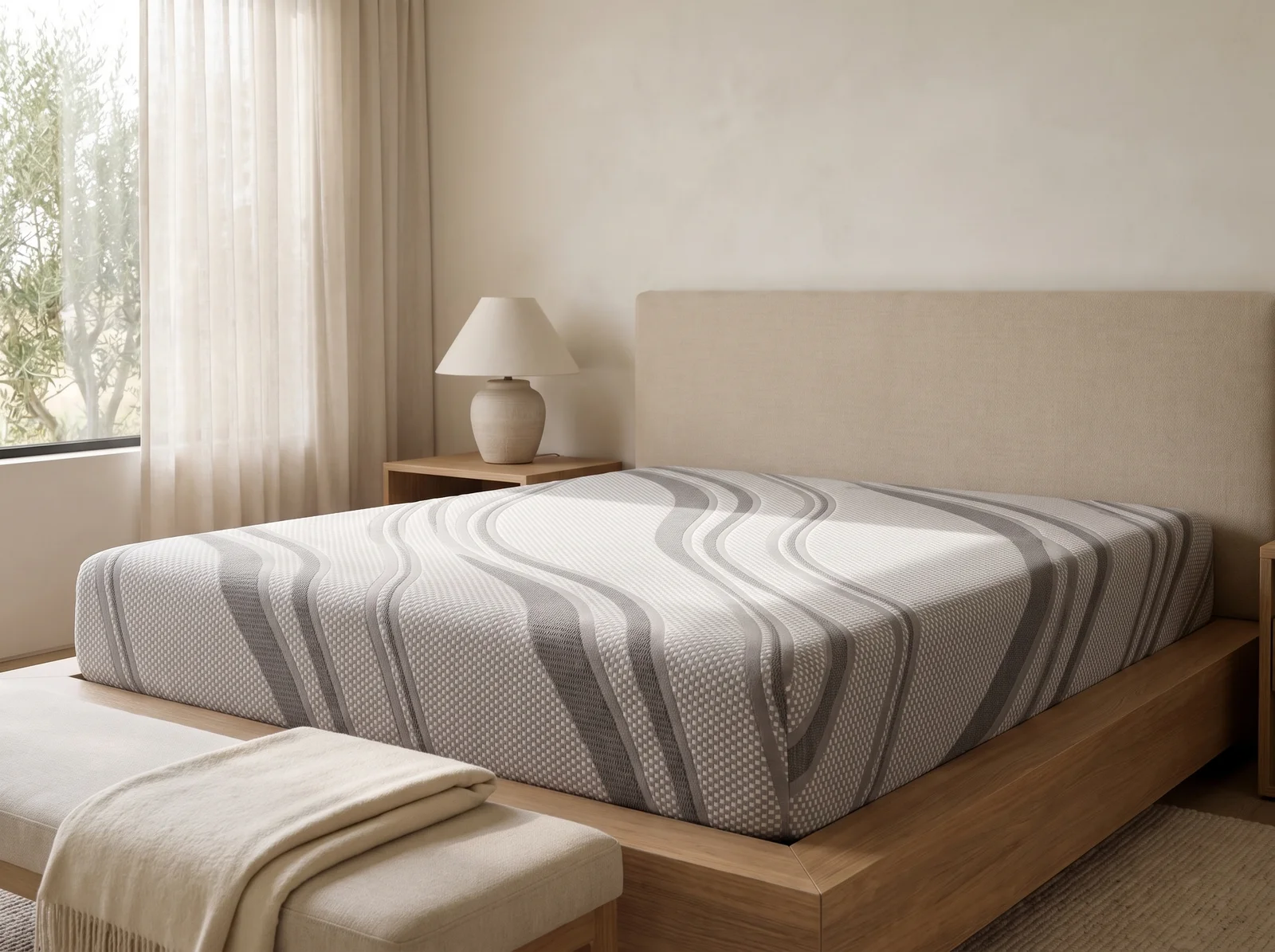
Viscoelastic foam is the material commonly called memory foam: a type of polyurethane foam that contours under pressure and recovers gradually after the pressure is removed. It can sit above a foam core or a coil system. The whole mattress determines the feel.
It gives. It contours. It gradually comes back.
“Viscoelastic” combines two ideas: a response that develops with time, and an ability to recover its shape. That is why pressing a hand into some memory foams leaves a temporary impression after you lift it away. The foam has not learned your body shape.
Formulations vary. Some recover faster than others, and temperature can change how they respond. The illustration below explains the sequence; it does not time or measure a particular mattress.
Conceptual foam sample · not to scale
Under pressure
The foam contours beneath pressure. How far it settles depends on the formulation, load and surrounding layers.
What if the room feels different?
Temperature can influence the response of viscoelastic foam. Formulation, pressure and the complete mattress construction also matter.
Qualitative explanation only. The drawing does not predict a recovery time, temperature or product performance.
A hand press can show response. Lying down and changing position tell you more about comfort.
One comfort material. Two common mattress builds.
Memory foam is a specially formulated, cellular polyurethane material. Its chemistry and manufacturing process are adjusted to produce its characteristic response. It is different from conventional polyurethane support foam, even though both belong to the same broad material family.
A memory-foam mattress usually contains several materials. Look for the comfort layer, any transition layers and the support core. A 12-inch mattress is not necessarily 12 inches of memory foam. These simplified cross-sections show where the material can go.
Comfort foam over foam
Comfort foam over coils
Conceptual constructions. Actual layer count, materials and proportions vary; these are not cutaways of the products below.
Density, firmness and thickness answer different questions.
How much does a volume weigh?
Usually listed in pounds per cubic foot or kilograms per cubic meter. Compare the same type of foam; density is not a softness score or a promise of a particular lifespan.
How much does it resist pressure?
A surface-feel property. A dense foam can be soft, and a less-dense foam can be firm. The finished mattress also depends on the layers beneath it.
How much material is there?
A layer depth and the total mattress height are different numbers. Ask which one a specification describes. More inches alone do not establish better support.
Within comparable foam types, density is one clue to how well the material may retain its properties. The full construction, use and supporting base still matter. If a layer specification is not published, ask for it; do not estimate density from a photograph or use mattress weight as a substitute. For a profile comparison, use our visual mattress-thickness guide.
The appeal: close contouring and a quieter surface.
A more cradled feel
The material can adapt around contact points. Compare how your shoulders and hips settle, rather than assuming every memory-foam model feels deeply soft.
Less surface springiness
Memory foam tends to damp movement rather than rebound sharply. That can appeal to partners disturbed by movement, although the rest of the bed still matters.
More than one kind of mattress
You can compare memory foam over a foam core with memory foam over pocketed coils. A hybrid may offer the contouring you like with a different response underneath.
The tradeoffs are worth trying in person.
Turning over
A slow, deep hug may take more effort to move through. Roll from your usual sleeping position and sit up; do not choose from a hand-press test alone.
Temperature
Some formulations soften with warmth. Covers, comfort layers, protectors, bedding and room conditions all influence your experience. Gel or “cooling” in a name does not establish an all-night result.
The edge
Sitting at the edge concentrates your weight differently from lying down. Check both, especially if you use the edge to get dressed or stand up.
A new-mattress smell
Follow the manufacturer’s unpacking and ventilation instructions. Odor alone is not a measurement of emissions; ask about the exact product and any documented certification.
Memory foam, TEMPUR and latex: decode the names.
Memory foam / viscoelastic foam
Two names commonly used for the same material category. “Visco” in a listing usually points to this contouring foam, not a separate support system.
TEMPUR material
Tempur-Pedic’s proprietary material family. Compare the exact model and feel; a brand name does not make every mattress in the range identical.
Gel memory foam
Memory foam formulated with gel. Ask what the full construction changes, rather than treating the ingredient as a temperature guarantee.
Latex foam
A different foam category, commonly chosen for a more buoyant response. Natural, synthetic and blended formulations exist; check the actual composition and try the feel.
Want the broader map? Compare mattress materials, then narrow your choice using the Firmness Finder.
Check what a foam certification actually covers.
CertiPUR-US certifies flexible polyurethane foam for specified content, emissions and durability requirements. It does not certify an entire mattress, every product from a listed company, latex foam or your personal comfort.
Ask whether the foam in the exact model you are considering is certified and request the supporting information. A low-emissions certification is not a claim of zero emissions, organic materials or a medical benefit. Read the CertiPUR-US certification FAQ to check the scope.
Three ways to experience memory foam.
These models show how the comfort material can be paired with different support systems. Product photos and links come from the current catalog. These are construction examples, not a ranking from laboratory tests.

Diamond ProGel Medium Gel Memory Foam Mattress - 10"
Diamond ProGel Medium 10-inch combines gel-infused memory foam with firmer support foams. A useful example of an all-foam construction; gel is an ingredient, not a guaranteed overnight temperature.
See Queen options & current price
Tempur-Pedic TEMPUR-ProAdapt® Soft Memory Foam Mattress - 12"
The ProAdapt Soft 12-inch uses TEMPUR comfort materials above a foam base. Compare how the soft surface contours and how easily you change position.
See Queen options & current price
Tempur-Pedic TEMPUR-ProAdapt® Medium Hybrid Mattress - 12"
The ProAdapt Medium Hybrid 12-inch pairs TEMPUR comfort material with pocketed coils. It illustrates why a mattress can contain memory foam and also be a hybrid.
See Queen options & current priceCurrent product photography; photos may show a different size or configuration. Links select Queen where offered. Bases and furnishings shown may be sold separately.
A useful showroom test takes more than a hand press.
- Start in your normal sleep position. Notice pressure at the shoulders and hips, and how far your middle settles.
- Change position. Roll over, sit up and get out of bed. Decide whether the contour feels comfortable or restrictive.
- Bring your partner into the test. Have one person turn while the other lies still. Try the edge as well as the center.
- Compare one change at a time. Try an all-foam model and a hybrid in a similar feel, then confirm the exact size, support and return terms.
Call ahead to confirm your shortlist is on display and find a showroom. If you are also changing the bed frame, start with the foundation and bed-height guide.
Memory-foam questions, answered.
Is viscoelastic foam the same as memory foam?
In mattress shopping, yes: the names commonly describe the same foam category. Our response illustration explains what the word means.
Is all polyurethane foam memory foam?
No. Memory foam is one type of polyurethane foam. Conventional foam may be used for cushioning or support without the same slow recovery. See the construction diagrams.
Does a memory-foam mattress have springs?
It can. An all-foam design has a foam support core; a memory-foam hybrid pairs comfort foam with coils. The pocket-coil guide explains the spring terminology.
Is higher-density memory foam always firmer?
No. Density and firmness are separate properties. Read the three-specification comparison and try the actual mattress.
Does a foam certification cover the entire mattress?
Not necessarily. CertiPUR-US covers flexible polyurethane foam, not every component of the finished bed. Check the certification scope and ask about the exact model.
Does gel memory foam guarantee cooler sleep?
No single ingredient establishes your overnight experience. Compare the whole bed and your bedding; start with the temperature tradeoff.
How thick should a memory-foam mattress be?
Choose the feel and appropriate support, then check the complete bed height and bedding fit. Our visual mattress-thickness guide compares actual profiles and foundation heights.
Can memory foam go on an adjustable base?
Some finished mattresses are designed for articulation, but verify the exact pairing. Use the adjustable-mattress compatibility checklist.
Keep the next question simple.
Understand the springs
Pocket coil vs. innerspring → explains how coil constructions relate to hybrids.
Measure the whole bed
visual mattress-thickness guide compares real profiles and the foundation beneath them.
Build a starting shortlist
The Sleep Quiz → organizes your preferences before you try mattresses.
Material background: Polyurethane Foam Association: viscoelastic foam and foam performance. Model-specific details come from current product descriptions.
Find your kind of comfort.
Choose a few constructions to compare. We’ll help you check the exact model, size and support before you order.